Pick a real place, generate the streets and buildings, then try to survive there
KnoxMap uses OpenStreetMap data to turn a hometown, neighborhood, park, or city block into an installable Project Zomboid Build 42 map.
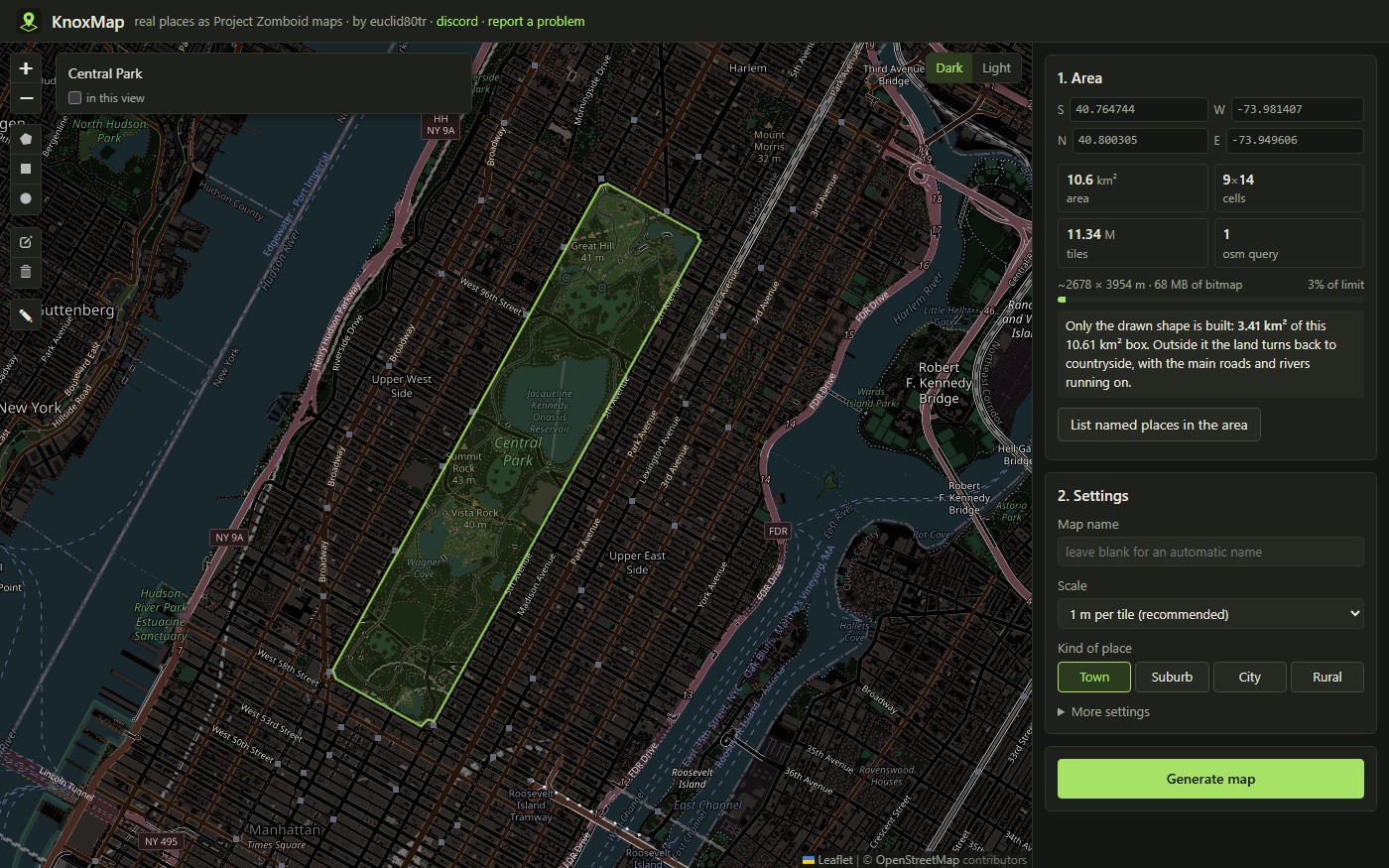
A new community tool is taking the familiar idea of surviving the zombie apocalypse somewhere much closer to home. KnoxMap lets players select an area on a real map, generate terrain and furnished buildings, compile it, and install the result as a Project Zomboid mod.
The project was revealed publicly on September 16, 2026, and it has kept changing almost daily. Version 1.4 arrived on September 23 with a major shift: KnoxMap stopped hard-blocking oversized areas and began warning players about the memory and processing cost instead, opening the door to much larger city-scale experiments. Version 1.4.2 followed on September 27 UTC, early September 28 in Manila, with another round of interior, compiler, and reliability fixes. It is another wonderfully strange player-made experiment, in the same spirit as PlayDOOM turning a Reddit post into a complete Freedoom campaign.
Want more unusual game projects like KnoxMap?
Get more fan projects, retro revivals, developer stories, indie coverage, and gaming news from Fix Gaming Channel.
Join Our Newsletter
Stay updated with the latest interviews, previews, and indie gaming news.
How a real place becomes a zombie map
KnoxMap reads roads, building footprints, water, parks, railways, land use, street names, and mapped building heights from OpenStreetMap. It then adapts those features to the tile-based world of Project Zomboid.
Buildings are generated on their real footprints, but their interiors are invented for play. A mapped pizza restaurant can become a dining room and pizza kitchen, while banks, pharmacies, hotels, schools, churches, clinics, offices, and factories receive room types and furniture suited to their purpose. The tool also estimates where people lived and worked to create an adjustable zombie-density map.
Players can search for a place or draw a rectangle, polygon, circle, or freehand boundary. The result can include roads at mapped widths, bridges, waterways, railways, monuments, multi-floor apartments, street labels, parked cars, and buildings up to 30 stories where height data is available.
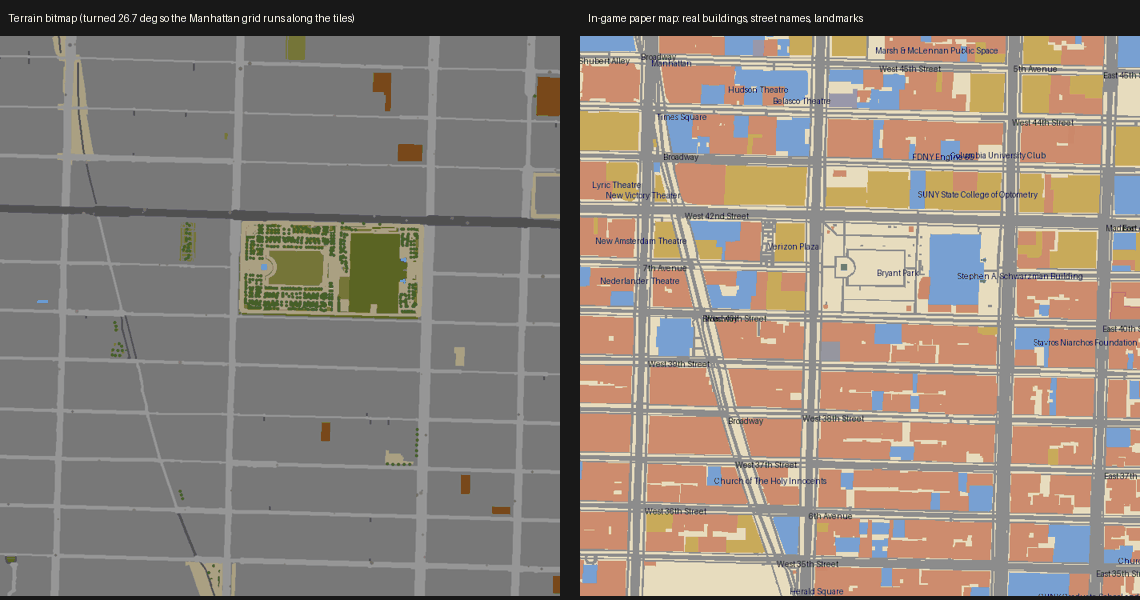
Midtown Manhattan around Bryant Park as a KnoxMap terrain bitmap and the labeled paper map generated for players. Map data © OpenStreetMap contributors. Image: euclid80tr / KnoxMap.
Version 1.4 opened the door to much larger city-scale maps
The September 23 update changed how KnoxMap handles ambitious selections. Earlier builds refused areas over 400 square kilometers, maps wider than 9,000 tiles, or jobs estimated to exceed the PC’s available memory. Version 1.4 turns those hard stops into warnings. The Generate map button stays available, while KnoxMap estimates the tile count, memory use, and number of OpenStreetMap requests before the player decides whether the hardware cost is acceptable.
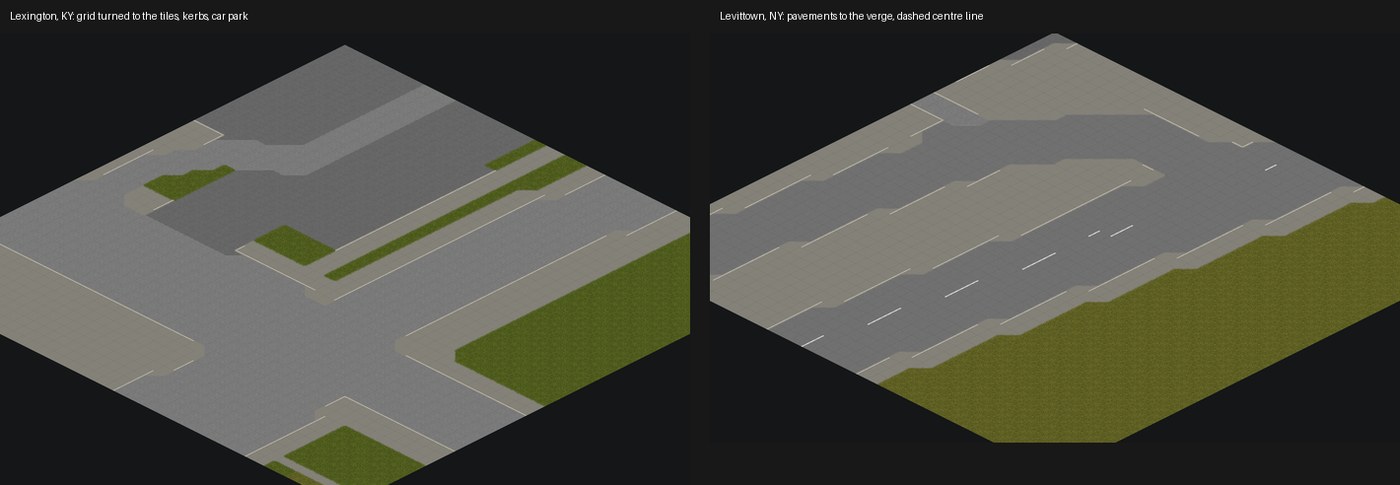
KnoxMap road layouts for Lexington, Kentucky, and Levittown, New York, rendered from map files with Project Zomboid tiles. These are output renders, not gameplay screenshots. Tile artwork © The Indie Stone. Image: euclid80tr / KnoxMap.
Version 1.4 also added an optional Fill gaps from Overture setting. It supplements OpenStreetMap with building footprints from Overture Maps where local mapping is incomplete. The developer’s comparison found only 60 additional buildings beside 1,962 mapped in Gifhorn, Germany, but 761 additions beside 473 mapped in Ürgüp, Turkey. The option is off by default because its usefulness depends heavily on the area and it adds extra processing.
The older detail work is still there too. Rows of shops can be divided into separate units, houses can be generated from address points where footprints are missing, and police stations, libraries, fire stations, graveyards, military areas, open countryside, parked cars, street labels, and multi-floor buildings all have their own generation rules.
Version 1.4.2 is already fixing interiors and Linux problems
Version 1.4.2 was published on September 27 UTC, early September 28 in Manila. Its changelog focuses on generated interiors, reliability, and Linux compilation. Corridors and stair halls receive more wall decoration and rugs, furniture is cleared away from doorways, oversized two-story buildings are more likely to become multiple flats instead of one giant house, and doors that land on problematic wall corners are moved where possible.
The same release addresses native 64-bit Linux compiler failures by forcing the bundled Qt libraries and plugins to load instead of incompatible system copies. Current Linux setup can fetch a native map compiler directly, so the normal 64-bit Linux compile path no longer depends on Wine. macOS and unsupported Linux setups can still fall back to the Windows compiler through Wine.
Version 1.4.2 also repairs paper-map outlines that could fail in dense areas and makes OpenStreetMap downloads more resilient when an Overpass server drops individual tiles. Separate Windows, Linux, and macOS packages remain available from the current release page.
A fast-moving community project built on earlier tools
KnoxMap is made by euclid80tr and builds on Knoxify, arytek’s earlier terrain generator. It also uses community mapping tools based on TileZed and WorldEd. The public release history now runs from the first September 16 release through version 1.4.2 on September 27 UTC, with player reports repeatedly feeding into fixes and new features.
That rapid iteration recalls other community projects where a player turns existing technology into something unexpectedly useful, including the playable Croatian translation of The Witcher 3 built by a first-time modder. Here, the unusual part is scale: the same workflow can be pointed at a few familiar streets or a dense city center.
What players need to know before trying it
KnoxMap currently has release packages for Windows 10/11, Linux, and macOS. It requires an internet connection and a Steam installation of Project Zomboid Build 42; Build 41 is not supported. On Windows, setup can use an existing Python installation or download a private copy. Linux and macOS require 64-bit Python 3.10+ supplied by the user, while 64-bit Linux now receives a native map compiler during setup instead of requiring Wine for the normal compile path.
The project is also very new. Its documentation says multiplayer and dedicated servers have not been tested, large maps can take significant time and memory, interiors are generated rather than copied from real floor plans, and the output depends on how complete OpenStreetMap data is for the selected area. Winding streets and angled buildings can also look stepped when translated to the game’s tile grid.
Early community reports are mixed, which is worth keeping in mind. One player reported successfully generating a map of their Brazilian city with real streets, street names, and OpenStreetMap-derived buildings, while other testers have reported rough building placement, jagged angles, and maps that still need improvement. The developer is continuing to update the tool around those reports.
Fix Gaming Channel has not independently installed or played a generated map. The workflow, compatibility, fixes, and current limitations described here come from the public repository, release files, documentation, and developer posts, with community reports used only as additional context.
There is one more sensible warning in the project documentation: these maps use real places, even though their interiors, loot, residents, and zombie populations are invented. Players should be thoughtful about maps based on homes, schools, hospitals, or places of worship, and shared maps must retain the required OpenStreetMap attribution.
The KnoxMap 1.4.2 release covered here is available free through GitHub. It is unofficial, non-commercial, and is not made, endorsed, or supported by The Indie Stone.
KnoxMap
Version covered: 1.4.2, released September 27, 2026 UTC
Type: Unofficial Project Zomboid Build 42 map generator
Developer: euclid80tr, built on Knoxify by arytek
Platforms: Windows 10/11, Linux, macOS — GitHub download
Related Reading
PlayDOOM Turns a Reddit Post Into a Complete Freedoom Campaign
33 Years Later, One of Robbo‘s Original DOS Programmers Brought It to Playdate
A Fan Recompiled Dead Rising 2‘s Xbox-Only Case Zero and Case West for PC, Then Restored Co-Op
Written by Ronny Fiksdahl, Founder & Editor-in-Chief of Fix Gaming Channel.
Send interview pitches, corrections, tips, or developer stories to contact@fixgamingchannel.com.
Support independent games coverage on Ko-fi.