Game code and several video streams now share one magnetic tape
Throaty Mumbo tried the 1987 Action Max, found its limited VHS interactivity disappointing, and responded by building a new tape-based game system of his own. His work-in-progress GCVHS project records game bytecode, timing information and multiple video streams into a single composite signal that can be stored on an ordinary VHS cassette.
It is another case of old hardware becoming useful in a way its original designers never planned. Audiowanderer recently turned an original Game Boy into the four-channel DMGo! drum machine; Throaty Mumbo is giving magnetic tape code, branching video and controller inputs.
Watch Throaty Mumbo demonstrate the VHS console in “Can We Port Video Games to VHS?” on YouTube. The video contains strong language.
Want more strange hardware experiments like GCVHS?
Get more game features, reviews, interviews, indie coverage, and retro hardware stories from Fix Gaming Channel.
Join Our Newsletter
Stay updated with the latest interviews, previews, and indie gaming news.
The Action Max was the problem, not the idea
Worlds of Wonder released the Action Max in 1987. Its games played prerecorded footage while a light gun registered shots, but the tape itself followed the same sequence regardless of what the player did. Throaty Mumbo bought and tested the system decades later, then decided the basic idea deserved a more ambitious interpretation.
His answer keeps the VCR at the center of the machine while moving the interactive work into custom electronics. The tape is no longer just a movie with targets. It carries information that separate hardware can decode and use to change what happens next.
One tape carries code, video and timing
According to the GCVHS project repository, game bytecode and several video streams are encoded into one composite signal before that signal is recorded to VHS. Playback feeds the signal into a DE1-SoC board, where an FPGA separates the information for the rest of the system.
A PGA2350 controller board built around the RP2350 microcontroller runs the decoded game code, handles player input and composites the selected video stream for the television. Timing data can also drive an infrared blaster, letting the system command the VCR to seek forward or backward when a game needs another section of tape.
The public repository is explicitly marked as a work in progress. Throaty Mumbo says it is temporarily sparse while he prepares the firmware shown in the video, so there is no finished package for players to download or a consumer console to buy.
Mario and Doom use the tape differently
The Super Mario Bros.-style experiment places familiar game elements over scenery reproduced from VHS. The analog background drifts and smears in ways a cartridge image would not, while the player character and interface remain responsive through the custom hardware.
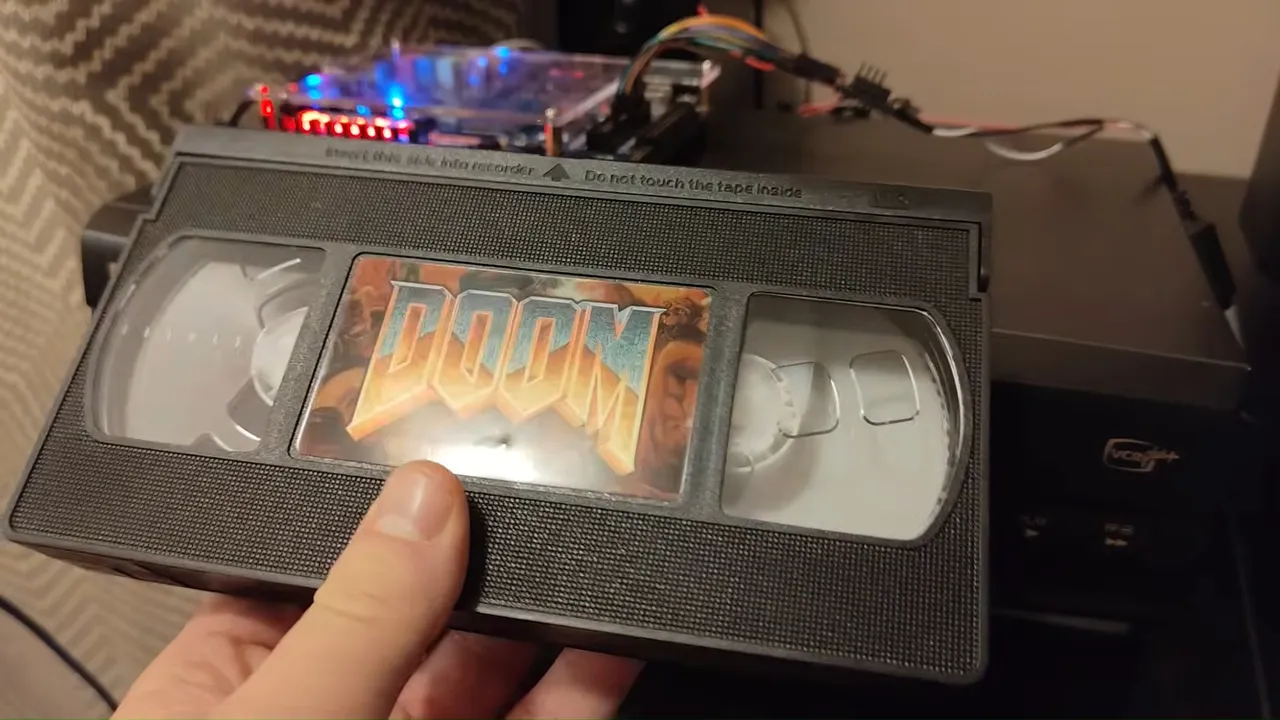
The Doom-style demonstration takes a different route. Prerecorded first-person sequences supply the movement through each encounter, while prompts ask the player for timed directional and shooting inputs. The hardware can choose among eight video streams based on those responses, creating branching paths and a score-driven challenge.
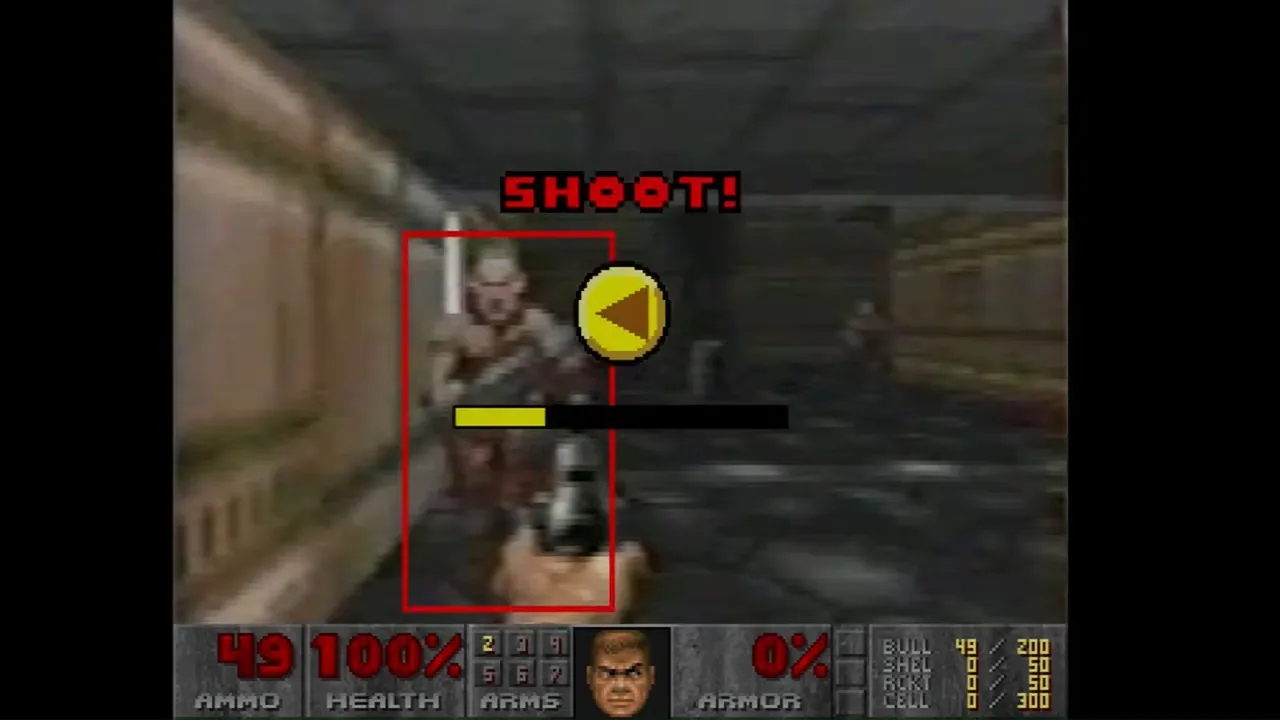
The Doom-style demo asks for timed controller inputs and selects among prerecorded video paths; it is not the original Doom engine running from tape. Image: Throaty Mumbo.
That distinction is important: this is not the original Doom engine executing from magnetic tape. It is a purpose-built, on-rails game experiment that uses Doom footage and interface elements to show how the VHS system can react to a player.
A working experiment, not a product announcement
Throaty Mumbo published the demonstration on October 2, 2026. The video proves that the core idea can work on his assembled hardware, but it does not announce a commercial release, price or completed public build.
Fix Gaming Channel has not built or tested the console. The project is documented through the creator’s demonstration and repository, and both remain works in progress.
That unfinished state is part of the appeal. A frustrating evening with a forgotten 1980s light-gun console led one maker to ask what interactive VHS could have been, then build enough hardware and software to answer the question with a tape labeled Doom.
GCVHS VHS Game Console
Status: Work-in-progress hardware and firmware experiment
Creator: Throaty Mumbo
Hardware: DE1-SoC FPGA board, PGA2350/RP2350 controller board, VCR and VHS tape
Demonstrations: Super Mario Bros.-style background experiment and Doom-style on-rails game
Project: GitHub
Video: YouTube
Related Reading
PlayDOOM Turns a Reddit Post Into a Complete Freedoom Campaign
33 Years Later, One of Robbo’s Original DOS Programmers Brought It to Playdate
Written by Ronny Fiksdahl, Founder & Editor-in-Chief of Fix Gaming Channel.
Send interview pitches, corrections, tips, or developer stories to contact@fixgamingchannel.com.
Support independent games coverage on Ko-fi.