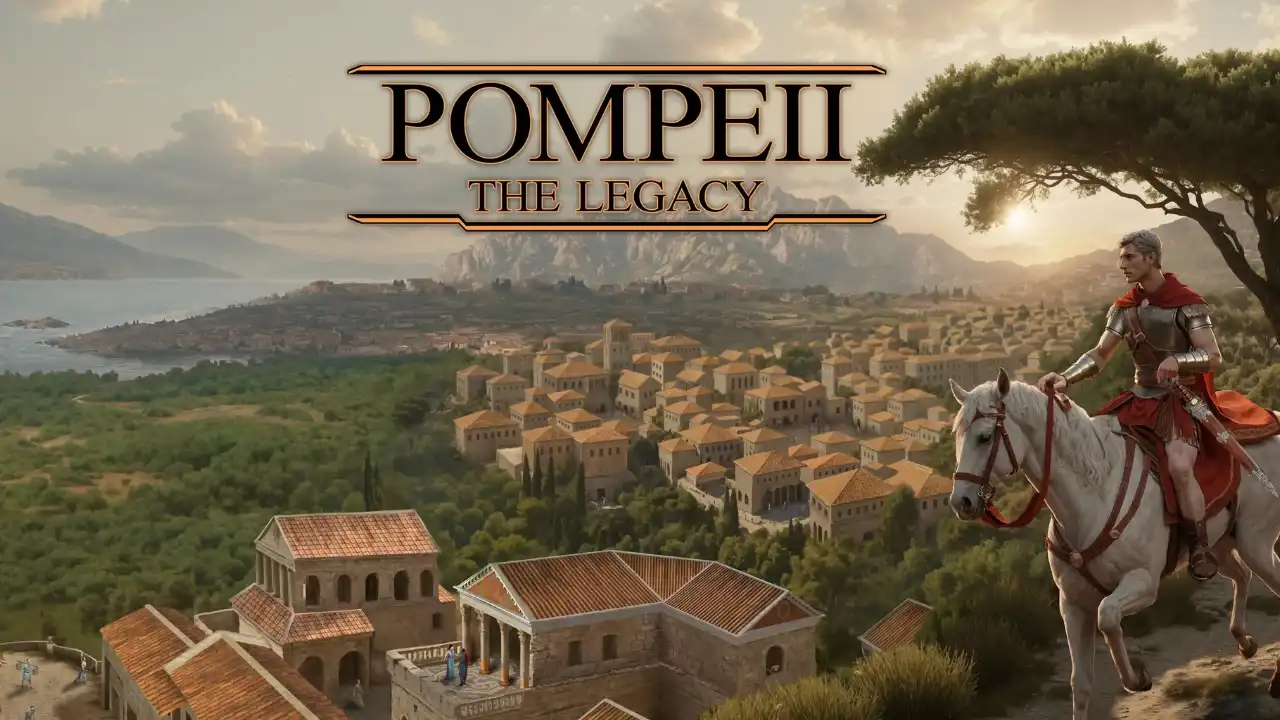
Pompeii: The Legacy, Siscia Games, and rebuilding a lost Roman city across generations
Pompeii: The Legacy is a historical city-building game set in 100 AD, where players take on the task of rebuilding Pompeii after the eruption of Mount Vesuvius.
Developed by Željko Kos at Siscia Games, the game uses his own WhaleX engine, built and refined for this kind of city-building project. The game follows generations of Roman life, from daily routines and trade to political decisions, family succession, historical events, and the long shadow of rebuilding a city that history left behind.
I spoke with Željko about how the idea came to life, the challenges of solo development, the lessons carried forward from Patron and Aquatico, and what it has been like recreating a version of Pompeii through design, research, and years of personal game development experience.
Editor’s note: This interview was originally conducted before the game’s full launch. Some store and release details have since changed, so the Game Info section below reflects the current Steam listing.
Pompeii: The Legacy – Full Release Trailer
Join Our Newsletter
Stay updated with the latest interviews, previews, and indie gaming news from Fix Gaming Channel.
Interview with Željko Kos
Q: What inspired the idea for Pompeii: The Legacy? Was there a particular moment or experience that sparked the concept?
Q: How has the game’s concept evolved from the initial idea to the version now ready for release?
When YouTubers started playing the city-builder Patron, which I worked on at Overseer Games, I often watched them play in the evenings. That’s when I’d also check out other games they were playing. One YouTuber, GamerZakh, had a lot of videos from the Caesar series. That’s when the first spark ignited in me, as I also loved playing Caesar and Pharaoh games as a student.
The fire took off when I spent my vacation early in the spring in Istria (a region in Croatia). There are many Roman archaeological sites there. When I visited the Roman Arena in the city of Pula, which was built around 100 AD, the idea of making a game about ancient Romans became so strong that I could no longer ignore it.
After several months of research that I did in my spare time, I finally came up with the first Game Design Document.
The WhaleX engine and technical challenges
Q: What were the most significant technical challenges you faced during the development of Pompeii: The Legacy?
Q: How did you overcome these challenges, especially considering the complex systems involved in a city-building game?
One of the reasons I’m working solo is that the company I co-own started developing games on the Unity engine, but I wanted to say goodbye to the engine I’ve been developing for 15 years. It’s an engine I know inside out, allowing me to quickly implement numerous features.
The biggest downside of the engine is the graphics system, which can’t compete with Unreal Engine 5 or Unity. However, judging by the players’ reactions to the screenshots from the game, I believe the graphics are at an appropriate level.
Most of the problematic features in the engine were tackled while working on previous games like Patron and Aquatico. I’m particularly referring to navigation and AI behavior on the map.
At the beginning of development, I focused on improving the visuals of the terrain and sea, which are very prominent parts of the game, frequently viewed by players of city-builders. I also made several other improvements, such as the Level of Detail (LOD) system for character models. This allows for more characters on screen without losing performance.
Pompeii: The Legacy Game Info
Pompeii: The Legacy
Full Release: April 9, 2026
Early Access Release: September 23, 2025
Genre: Indie, Simulation, Strategy, Historical City Builder
Developer / Publisher: Siscia Games
Platform: PC via Steam, GOG, Epic Games Store
Q: How does Pompeii: The Legacy compare to your previous games in terms of scale and ambition?
Q: Can you discuss any lessons learned from past projects that you applied to this game’s development?
I’ve learned many lessons throughout my work in game development. Each lesson significantly helps in a new project.
This project is unique because it’s the first time I’m working as a solo developer. For the first time, I have to take care of all aspects of the game. In some areas, I’ve hired external collaborators, such as for the visual UI, composing music, and certain 3D models (mainly buildings and characters). However, programming the engine, gameplay, creating concepts, making a large number of 3D models, and sounds in the game, story, scripting, community management, and PR are still all on my shoulders.
Despite this, the project is very ambitious. It’s certainly not smaller, nor less complex than Patron or Aquatico.
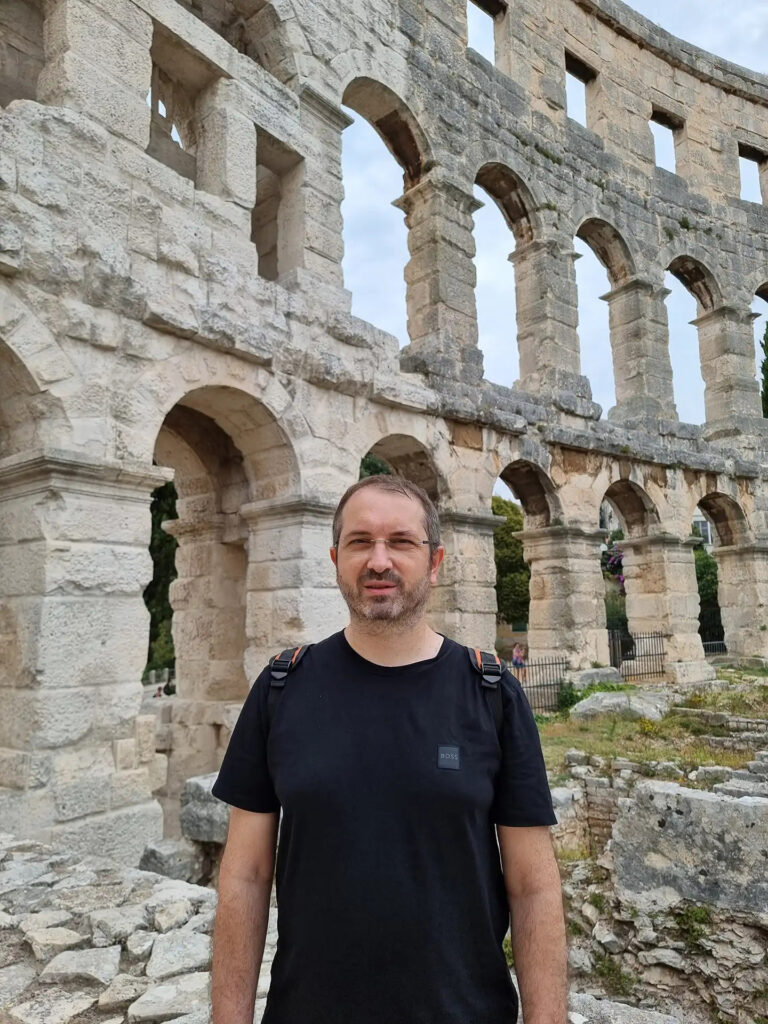
Željko Kos at the Pula Amphitheatre in Istria, Croatia, one of the real-world historical references behind the project.
Art direction and Roman atmosphere
Q: What can you tell us about the art direction for Pompeii: The Legacy? How did you decide on the visual style for the game?
Q: How do you ensure that the visuals effectively convey the historical setting and atmosphere of ancient Pompeii?
Although I’m not primarily a graphic designer, my journey in game development began over 20 years ago as a level designer. However since I produced many games in a small team, I often had to do minor graphic adjustments as well. This experience definitely helped me get this project off the ground and establish the visual identity.
I wanted to capture the Mediterranean atmosphere since Pompeii, in ancient times, was a typical Mediterranean city. The choice of warm colors and lighting greatly contributes to that ambiance. The game’s style is semi-realistic, providing the game with a unique visual identity. But to be honest, true Unreal Engine 5 realism is not achievable with my engine.
Family systems, politics, and Roman society
Q: How did you design the gameplay to reflect the social and political intricacies of Roman society?
Q: What are some of the unique gameplay mechanics players can look forward to that set this game apart from other city builders?
The initial version of the gameplay focused much more on city management and less on social aspects. However, as I delved deeper into the study of ancient Roman society, the social and political elements became increasingly important to the game.
Instead of having a single-player character span the 200-year campaign, I introduced a system where the player manages a family. The head of the family dies over the course of the game and is replaced by an heir. One interesting mechanic is the introduction of family bonuses that are passed down from generation to generation.
Since the game mirrors the realities of Roman society, the player will be able to manipulate these bonuses by choosing families with which to ally over time. Just as in the Roman Empire, the player will choose who will inherit the role of the head of the family, potentially steering the family in a different direction from the one initially chosen.
At the beginning of the campaign, the player will choose from one of five families, each with its own bonuses (and drawbacks). For example, one family may be financially oriented, another focused on construction, and another on trade. The campaign will follow the storyline of the player’s family, as well as the events of the empire, leading to interactions with Roman senators or, if the player rises high enough, even with the emperor himself.
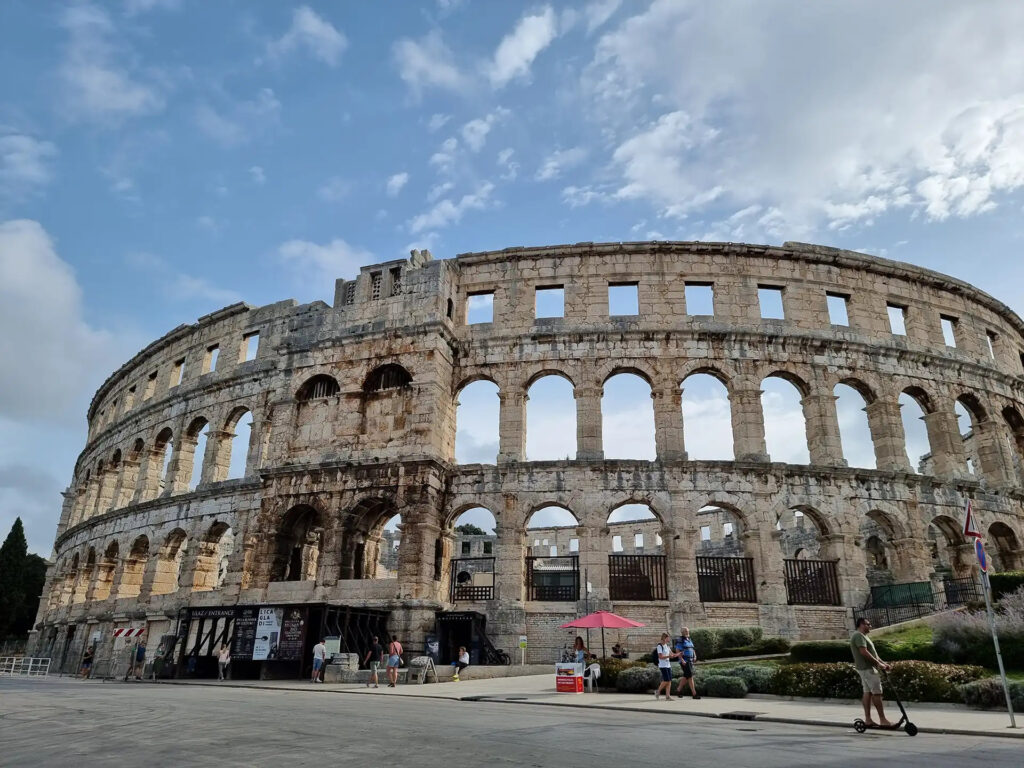
Exterior facade of the Roman amphitheatre in Pula, one of Croatia’s preserved Roman structures.
Career experience and personal references
Q: Reflecting on your career, how do you feel your experiences have shaped Pompeii: The Legacy?
Q: What has been the most fulfilling aspect of developing this game?
I believe the biggest advantage of my experience is that I’ve read countless books, watched numerous series and films, and likely read a truckload of comics over the years. When I start designing a specific feature in this game, references start flooding in on their own. Sometimes, I feel like Tom Cruise in Minority Report, when he’s moving virtual content around with his hands. This wealth of experience is one of the few benefits that come with age. Unfortunately, the rest mostly involve high blood pressure, stomach issues, and baldness 😊.
Each iteration of my engine has been an improvement because I’ve learned something new with each project. I’ve also been fortunate to work with colleagues who were sometimes better than me, and I learned a great deal from them.
Additionally, being born in Croatia, which was part of the Roman Empire in ancient times and has many well-preserved ancient structures, has been a significant advantage.
Historical research and daily life
Q: How important was it to represent the culture and daily life of Pompeii accurately, and what steps did you take to achieve this?
Q: How do you balance educational content with entertainment in a historically themed game?
The story begins 20 years after Pompeii was destroyed in a volcanic eruption. While the concept of rebuilding Pompeii is historically inaccurate, other historical events in the game will be somewhat accurate. Emperors will change as they did in reality, wars that affect trade will occur during the times they actually happened, and trade will be fairly realistic in terms of the resources that specific cities would have traded.
To capture the dynamic life of Pompeii, our residents will engage in numerous activities that were common in ancient times. Various ancient vehicles and litters will transport patricians throughout the city. Many ideas for depicting city life came to me after watching the series Roman Mysteries, which is based on the book of the same name.
Regarding the representation of culture and philosophy in the city’s life, one family member is designated as an advisor to the player on these matters.
Q: Can you describe the process of integrating your historical research into the gameplay and narrative of Pompeii: The Legacy? How do you decide which historical elements are crucial for the game’s authenticity?
Regarding the storyline, I’ve only developed the beginning of the game so far, which takes place during the reign of Emperor Trajan. Since the early stages of the game are meant to teach the player how the game works, I had to carefully balance between historical accuracy and creative imagination. Although the player is a Patrician, a member of high society, they wouldn’t realistically have direct interactions with the emperor. However, due to the player’s service to Trajan during the unrest in Pannonia, such interactions are possible.
Historical events will be integrated into the game through dialogues where the emperor’s envoy arrives in the city to inform the player of certain events. Some events, like wars during historically accurate periods, might negatively impact trade routes. Writing the story and integrating it into the game will be one of the biggest tasks for me in the remaining development phase.
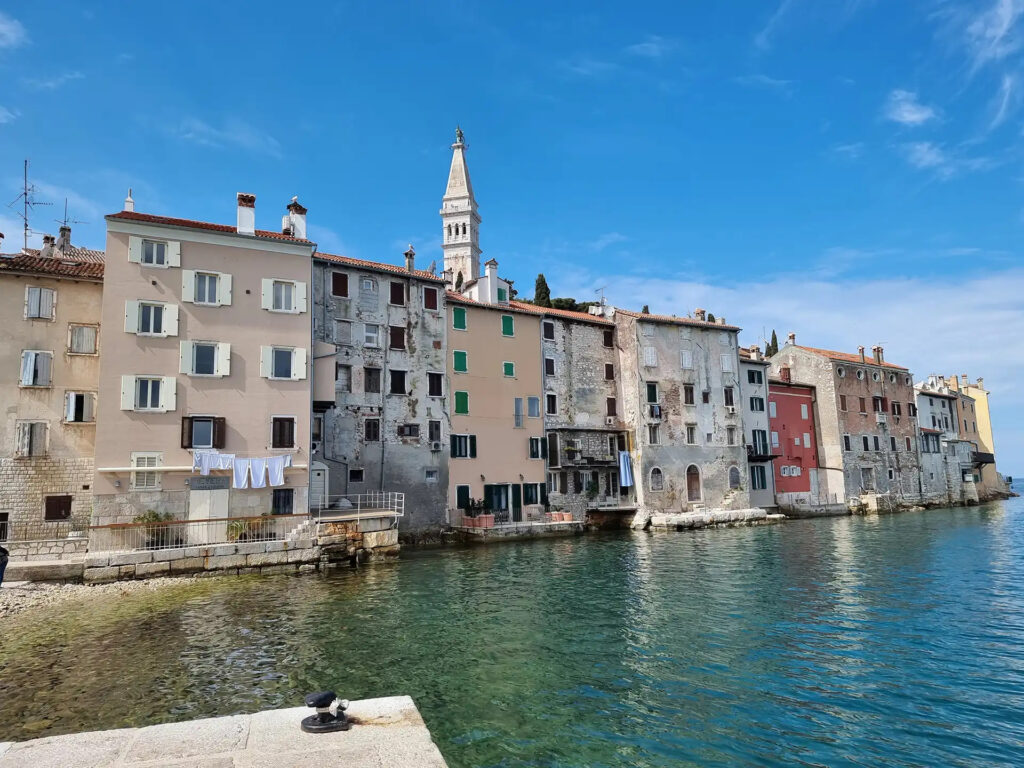
Rovinj old-town waterfront in Istria, Croatia.
Challenges of solo development
Q: Working as a solo developer can come with unique challenges and freedoms. Could you discuss how being the sole full-time employee at Siscia Games has influenced the development process of Pompeii: The Legacy? What have been the biggest hurdles and advantages?
When I decided to develop this game as a solo dev instead of as part of a team, I had over 20 years of experience in the game industry. Looking back, I think I may have relied too heavily on that experience. Right now, I find that my biggest challenge is time. To accomplish everything I plan, I would need days to last at least 36 hours.
The significant advantage of working solo is that I make all the creative decisions myself. If something doesn’t fit into the design, I can change it quickly. In a team setting, such changes would take much longer.
On the downside, carrying the entire development burden on my shoulders is incredibly taxing. My work often stretches late into the night. Perhaps it would have been easier if I had chosen to work on a smaller, less demanding game. However, I wouldn’t have felt the same sense of challenge that I do with Pompeii: The Legacy.
Role management
Q: Having transitioned from working with teams to handling the roles of developer, publisher, and promoter by yourself, how do you manage these diverse responsibilities?
I have numerous lists filled with tasks. At one point, I tried organizing tasks by day, but that didn’t work well, as I often had to push tasks to the next day, which felt like a failure. Now, I keep open-ended lists. This wouldn’t work in a team setting, where tasks from various members intertwine, but it works for me. I simply take tasks as they come and tackle them one by one. Unfortunately, I’m still in the production phase where the number of tasks seems to increase daily instead of decreasing.
At this point, just before the reveal, I barely have time to work on game development. I spent some time focusing on creating the trailer, and during that period, I could still manage some development tasks. After the reveal, I plan to dive back into development fully.
Commodore 64 nostalgia
Q: We both share a fondness for the Commodore 64, a system that sparked many creative journeys. Could you share how your early experiences with the Commodore 64 influenced your approach to game development?
When I was a teenager, before 1990, my parents bought me a Commodore 64. Initially, I spent my time playing games, playing, and playing some more. I think my friends and I broke at least a dozen joysticks. But then I discovered that I could also use programs on my Commodore 64. When I was about 15, a war started in Croatia. My town was about 30 kilometers from the front lines, and that year, we rarely went to school, so I spent most of my time on my Commodore 64. That’s when I learned to draw and program, and I think that’s when I realized I wanted to make games.
When I started technical university and first encountered serious software, it became clear to me that I didn’t want to design cranes and air conditioners—I wanted to make games. You could say that it’s the Commodore 64 that’s to blame for my career choice 😊.
Final Thoughts
Wrapping up this conversation with Željko Kos, one thing is clear: Pompeii: The Legacy is a personal project built with care, curiosity, and a deep respect for history. It marks a major step in his journey, showing how one developer can wear many hats and still create something ambitious in a crowded city-building genre.
From tinkering on a Commodore 64 to building his own game engine, Željko’s story is one of persistence, technical craft, and historical fascination. The result is a game that connects Roman history, city management, family legacy, and solo development into one long-term creative challenge.
Related Reading
For more developer conversations, visit our Developer Interviews hub. You can also explore more indie coverage through our Indie section.
Written by Ronny Fiksdahl, Founder & Editor of Fix Gaming Channel.
Got a historical game, city builder, or developer story we should see? Send it to contact@fixgamingchannel.com.