


A veteran game writer on the stories players create for themselves
Game narrative is not only about writing what happens. For Richard Dansky, it is about building the space where players step in, make choices, and turn authored worlds into personal stories.
In this Fix Gaming Channel interview, Aidan Minter speaks with Richard Dansky, whose work spans tabletop RPGs, live-action systems, novels, and major video game franchises including The Division, Splinter Cell, Ghost Recon, and Hunt: Showdown.
The conversation fits naturally into our wider coverage of creative work in games, from Art in Games to broader discussions with industry insiders about writing, design, production, and the craft behind interactive worlds.
Dansky talks about early literary influences, the difference between writing fiction and writing for player-driven spaces, the emotional tone of worlds like World of Darkness and Hunt: Showdown, and why Ghost Recon Wildlands connected so strongly with players.
Join Our Newsletter
Stay updated with the latest interviews, previews, and indie gaming news from Fix Gaming Channel.
A Conversation With Richard Dansky
1. Who or What would you say your writing inspirations are, who has had the biggest impact on you, or who do you resonate to in terms of fictional story writing and narrative work?
I have always been an omnivorous and voracious reader. Perhaps the first and biggest inspiration was Ray Bradbury, whose book The Halloween Tree I read in third grade when recovering from chicken pox. That book, more than anything else, set me on the path to where I am today. But I can honestly say I’ve taken inspiration from a veritable horde of authors from Charles L. Grant and Manly Wade Wellman to Kage Baker to comics writer Walter Simonson to Raymond Chandler to the old tentacled warhorse Lovecraft. Each of them taught me an invaluable lesson that I’ve integrated into my own work, and there’s a whole raft of others behind them who’ve also provided inspiration.
2. Has the process of game writing changed over the years or adapted for an interactive audience that seems to have their attention span distracted by streaming services, on demand music, food apps and so forth – is it harder for writers to reinforce narrative and storylines in these times?
I think there’s no simple or single answer here. There’s still very much an audience that craves deep and dense narrative, hence the Souls games. There are absolutely other gamers who just want enough narrative to know where to go, who to kill, and what to loot, but that’s cool, too. Today we as game writers have access to tools we couldn’t have dreamed of when I first started, from facial animations to unprecedented room to do things like audio logs. A good game writer takes advantage of all of those to hit each audience where they want to be addressed. So, to loop back to the original question, it may be harder to just communicate a simple story, but that’s not really the job any more, and the challenge of using all these tools to address all these audiences simultaneously is part of what makes the job interesting.
3. You’ve written across tabletop RPGs, live-action systems, novels, and AAA video games like The Division, Splinter Cell, and Hunt: Showdown. How does your storytelling process change when you’re writing for a player-driven medium versus a fixed narrative form like fiction, and what principles stay constant across all of them?
Each form has its own rules, needs, syntax, and terms, and I actually find bouncing back and forth to be quite refreshing. That’s because writing for video games exercises writing muscles that fiction doesn’t, and vice versa.
The big difference, of course, is interactivity, and in terms of composition that functionally translates to control – control of characters, control of pacing, control of action, etc. In linear media, you have that, and can craft things accordingly and in a certain kind of fine detail. In an interactive medium, you don’t have that, and as a writer you have to absent yourself from the heart of the narrative. Instead, we have what I call “The Player-Shaped Hole”, the void at the center of the game narrative where the player inserts themself and becomes the real hero of the story they generate through play. And as such, when you write for a medium like that, you’re not writing “what happens”, you’re writing against all the possibilities of what might happen – does the player go left or right or reload or turn around or or or – and making sure that whatever the player chooses, in feels like the right next step in the story.

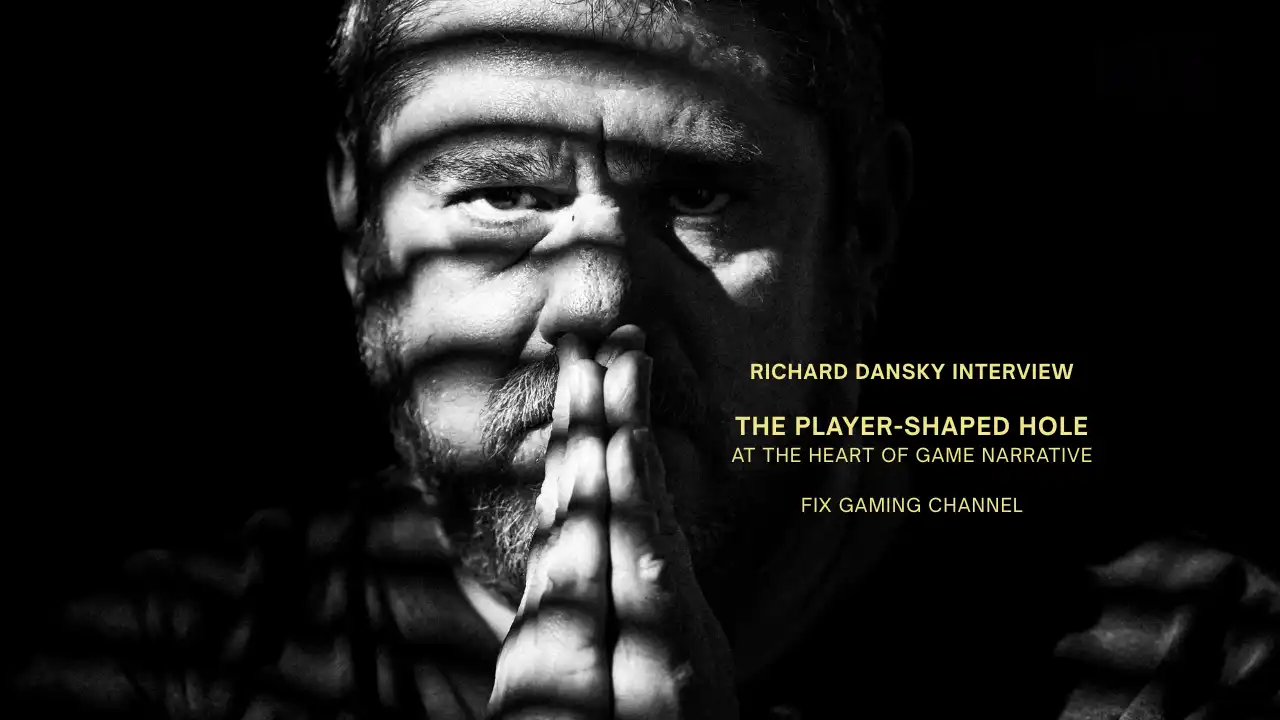
Richard Dansky discusses writing for player-driven worlds, where the player becomes the real hero of the story. Image courtesy of Richard Dansky.
4. Looking back from Wraith and Vampire: The Dark Ages through more than two decades in AAA games, what’s one major lesson about narrative design or collaboration that fundamentally changed the way you work?
It was the realization that in fiction, I was writing the story, but in games, I was writing the narrative. That’s to say what I do writing games – and while there are important differences between TTRPGs and video games – is to create the equivalent of the set and the props and the backdrop scenery and the costumes and all the other stuff that just sits there until the player comes along and inhabits or interacts with it. In that moment, it becomes part of the story they are telling through their unique play experience. As such, my job is to make those narrative elements as compelling and flexible as possible to make sure the story the player creates with them is one they are happy they created.
5. Your work spans very different tonal spaces—from the gothic intimacy of World of Darkness to the militarized realism of the Tom Clancy universe and the atmospheric horror of Hunt: Showdown. How do you approach building a world’s emotional tone so that it feels distinct yet still supports gameplay?
It really boils down to asking a lot of questions. What is the world for? What do we want to have happen in it, both in terms of high level arc and moment to moment? What possibilities should it contain? Answering those questions in turn leads me to what tools I should be using, from the people (and things) inhabiting the space to their unique voices to the bits of history that are told – and left untold. Form really does have to follow function here – if the gameplay doesn’t allow for dance-offs, building an army of NCPs who are all clones of Rudolf Nureyev doesn’t make a lot of sense – but I view that as inspiration, not restriction. Understanding the purpose of the elements of the world lets me imagine and tune those elements properly to achieve the desired effect. It lets me draw the golden circle for each world I’m creating, and to be able to see as a result where each idea falls – inside or outside.

Hunt: Showdown reflects the kind of atmospheric horror and tonal worldbuilding discussed in the interview. Image credit: Crytek.
6. You’ve been involved with so many hit games, but outside of your own catalogue, what’s one game you’d call a personal favourite, and why has it stayed with you?
I’m going to cheat and give you two here. The one game that, over my entire life I’ve put the most hours into is Dynasty Warriors, which you’d think would be an odd choice for a narrative person. But, if you look at my professional history and realize that Dynasty Warriors games are essentially a series of tactical puzzles you can attempt to solve in a myriad of different ways, it makes more sense. Throw in the fact that the games did such a good job of communicating the player power fantasy through every aspect, and I always found them to be a fun challenge that made me feel great about hacking my way through a thousand enemy soldiers to get a steamed bun and take down a fortress in the process.
And then to flip the script, I utterly adore What Remains of Edith Finch, which to me is the perfect match of mechanic to narrative to play experience. Each of the mechanics is a perfect fit for the narrative it’s supporting, none of them outstay their welcome, and all of them perfectly marry gameplay and narrative fantasy. Plus, the writing was just so very good. I recommend this one to people constantly.
7. Wildlands had a very specific mix of military realism, cartel violence, and open-world freedom. What made that setting especially interesting for you to write in?
I actually did very little for the Wildlands game, other than a sort of narrative support role. I did, however, throw everything I had into the Wildlands novel Dark Waters, which was a fascinating challenge. I mean, I’m a research hound under the best of circumstances, and then thinking about how aware and invested in realism that audience is, and wanting to do right by the subject material, well, it was really challenging in a good way. That sort of open structure of the game actually gave me license to attack the novel the way I wanted, which was to break out of a singular, small focus and instead play with all the settings and all the tools in the kit. The realism was a great baseline to work off of, because I could take even my craziest ideas and measure them against that. And wouldn’t you know it, some of them made the cut.

Ghost Recon Wildlands gave players a wide tactical sandbox built around planning, positioning, and mastery before the first shot. Image credit: Ubisoft.
8. Looking back, what do you think made Ghost Recon Wildlands connect so strongly with players compared with other military shooters?
Ghost Recon has always been about the moment before the shot, rather than the shot itself. The real moment of victory was when you had yourself or your squads in perfect position and had your target in your sights and had lined everything up, and had mastery of the combat space. Pulling the trigger was confirmation of what you had already done, and my hat remains off to Brian Upton and the original GR team who created that. It was a real pleasure and honor to be able to play in that sandbox and take that concept and apply it to narrative concerns. As for Wildlands in particular, I think it did an excellent job of expanding the scope of tools at the player’s disposal to achieve that sort of mastery. It was a broader experience where you could get to that moment in a million different ways, all of which were fun and cool and which you hadn’t been able to do before. But in the end, it still nodded to that notion, I think, that you won the battle before the first shot was fired.
Related Reading
For more conversations about the craft behind games, visit our Interviews hub, explore our Art in Games section, or read our feature on Choice of Robots and why AI stories still need human consequences.
Written by Aidan Minter — Fix Gaming Channel.
For interview pitches, industry stories, corrections, or developer features, contact contact@fixgamingchannel.com.