

Why Three Weather States and 36 Hand-Built Stages Became the Whole Game
For this Fix Stories contribution, Jim of Honest Little Apps explains the design choices behind RushOrb: Storm Atlas.
Some runners use weather as scenery. This developer set out to make it the core mechanic, with every obstacle responding to the player’s choice. This is part of Fix Stories, our first-person creator series.
For another firsthand mobile development story, read how Instant Estresso grew from a soundtrack into a game.
More Stories Behind the Games We Play
From solo development decisions to unusual game mechanics, keep up with original creator stories and independent gaming coverage.
Join Our Newsletter
Stay updated with the latest interviews, previews, and indie gaming news.
Making the Weather the Puzzle: The Decisions Behind RushOrb: Storm Atlas
By Jim, Honest Little Apps
Most runners treat weather as wallpaper. Rain streaks across the screen, snow drifts in the background, and none of it changes what your thumb has to do. RushOrb: Storm Atlas started from the opposite question: what if the weather was the control scheme?
The answer became the Weather Dial. You steer a small critter orb with one thumb and switch the weather with the other. Frost freezes ghost bridges solid so you can cross them. Blaze melts glass gates out of your way. Gale makes the orb lighter and lifts it over hurdles. Each call re-tunes the course instantly, so the weather stops being scenery and becomes the puzzle.
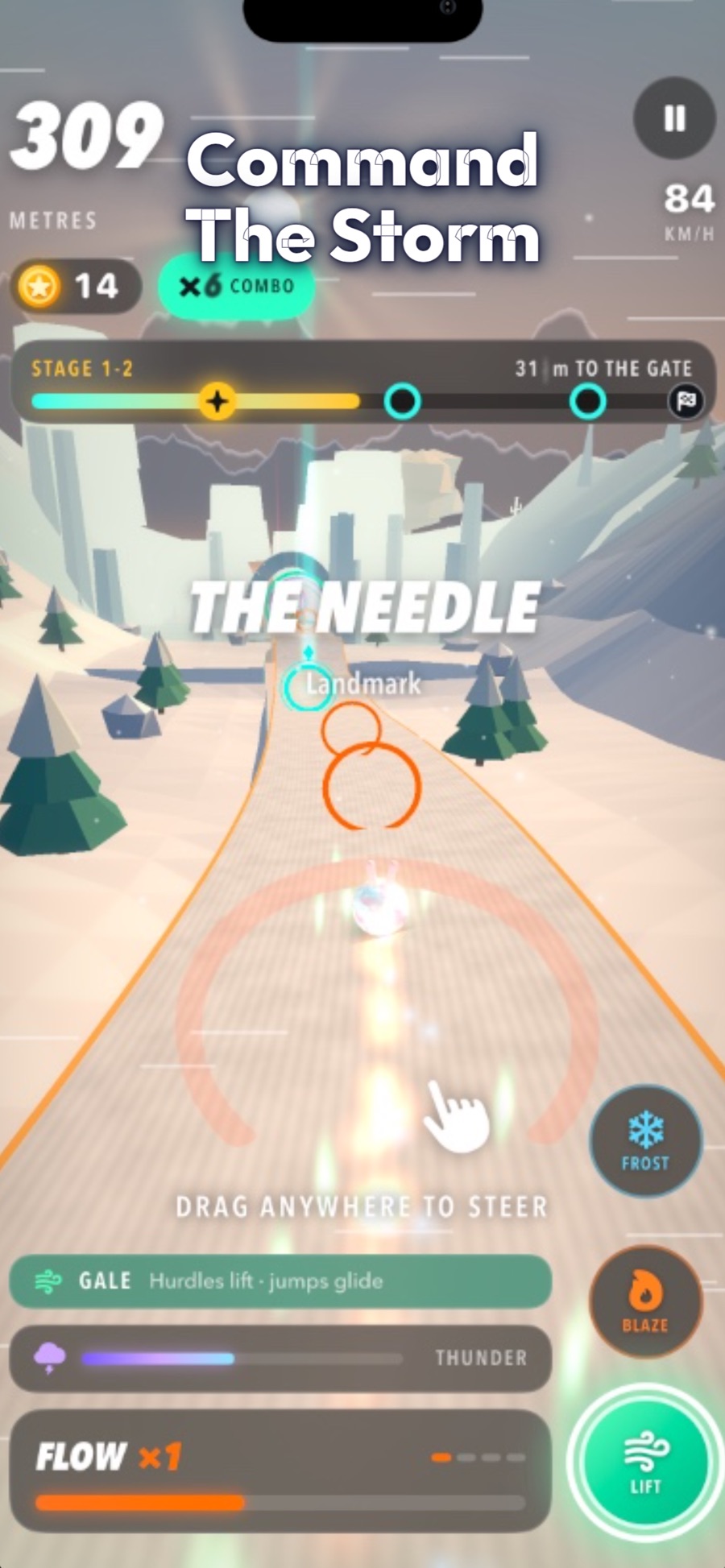
A run through an icy course with RushOrb’s weather controls on-screen.
Why three weathers, not ten
The early temptation with a mechanic like this is to keep adding states. More weather types sound like more depth. In practice, every extra option is something a player has to hold in their head while the orb is moving, and the game is meant to be played one-handed on a phone, often in short bursts. Three is the number that fits: each one has a single, readable job, and the challenge comes from timing and combining them rather than from remembering what a fourth or fifth one does.
That constraint also shaped the level art. Every obstacle has to say, at a glance, which weather it answers to. A ghost bridge has to look like it would hold if it froze. A glass gate has to look like it would melt. If a player fails, the goal is for them to know immediately which call they missed, not to feel the game was unfair.
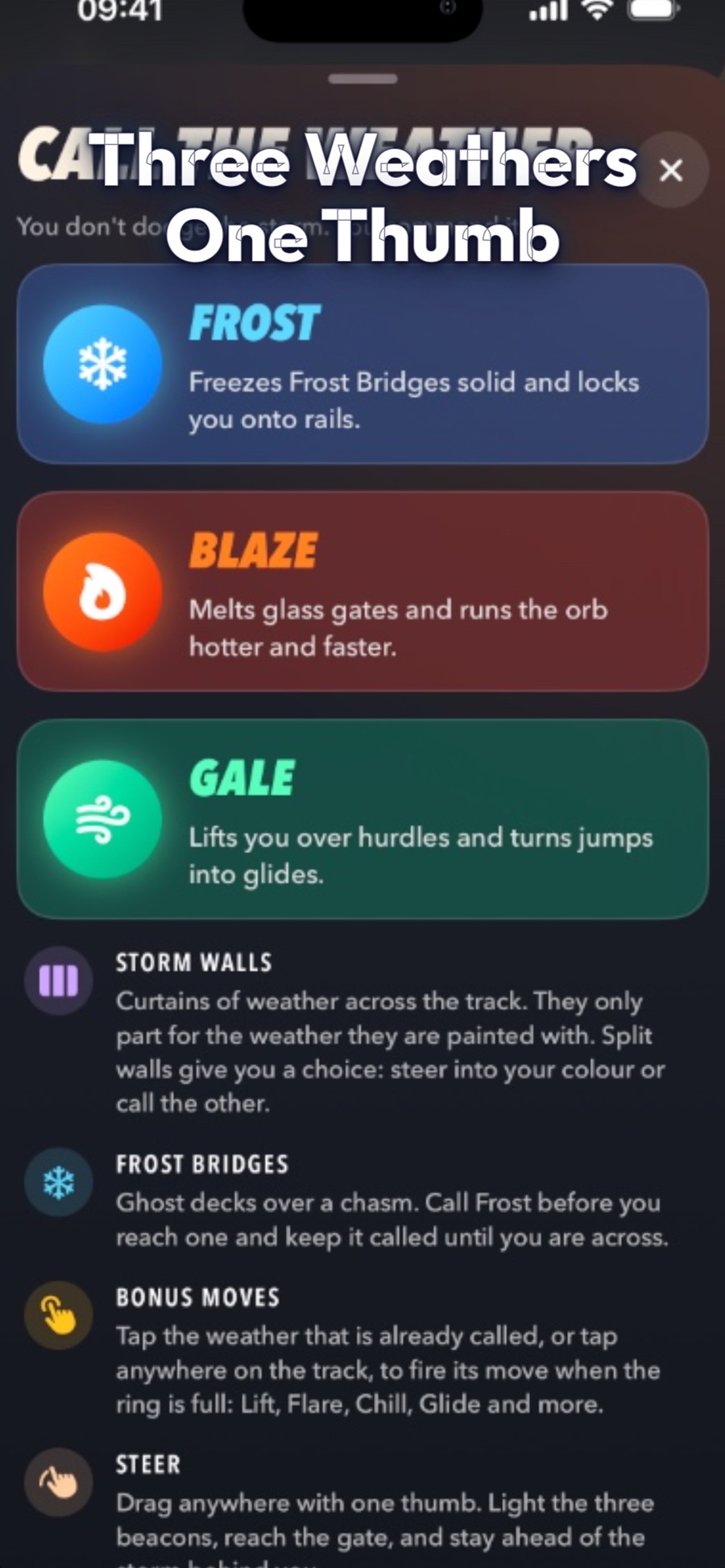
The Weather Dial uses three states: Frost, Blaze and Gale.
Why hand-built stages instead of an endless runner
A fair question about RushOrb is why it isn't simply an endless runner. Endless mode is in there, along with a Daily challenge that gives everyone the same seed for the day, but they sit on top of the main thing: 36 hand-built stages across six regions.
The reason is that the Weather Dial is a puzzle mechanic, and puzzles need authored moments. Procedural generation is good at variety, but it is hard to make it build the moment where you realise a frozen bridge, a melted gate and a gust have to happen in that exact order. Hand-built stages let each region introduce an idea, push on it and then combine it with what came before. Each stage has three beacons to light and its own challenge, such as parting Storm Walls or crossing Frost Bridges, and the 108 sparks across the game add up to completing the Atlas.
The aim was a journey with a sense of progress, not a high-score loop you grind until you put the phone down.
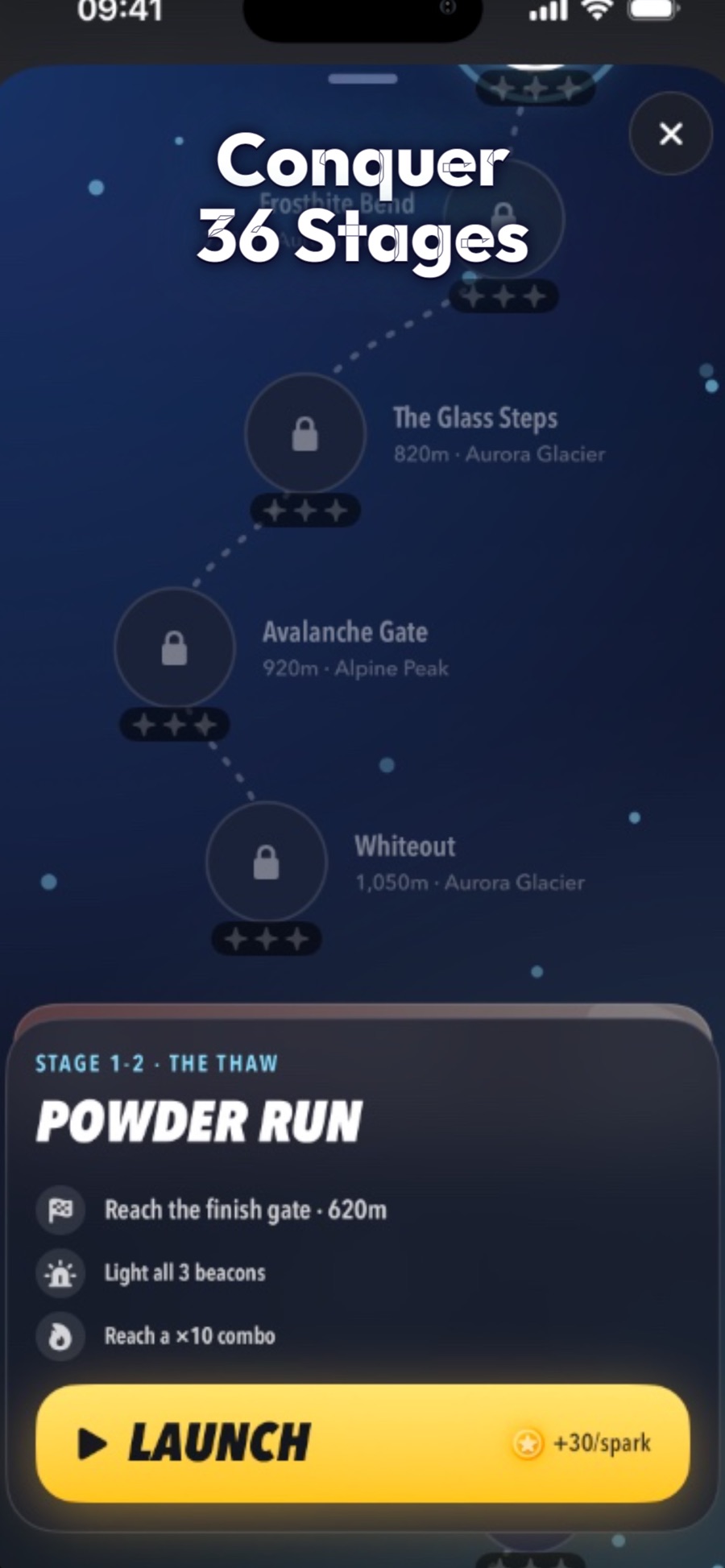
A stage-selection screen shows RushOrb’s objectives and progression.
The hardest part: making it readable at speed
The trickiest problem was not the weather logic itself. It was making a weather switch feel instant and fair while the orb is already moving. If the change lands a fraction late, or the player can't tell whether a bridge is solid yet, the mechanic stops feeling like a skill and starts feeling like luck. A lot of the work went into tuning that moment so that the call, the visual change and the result all read as one action.
One thumb for steering and one for the dial also meant thinking carefully about where controls sit on the screen, so that switching weather never blocks your view of what's coming.
Decisions about money
RushOrb has no ads, needs no account and plays fully offline. Coins are earned only by playing. There are optional cosmetic packs and an optional RushOrb Plus subscription, but they are for style and bonus rewards and are never needed to clear a stage. That was a deliberate line: if the game is a puzzle, the solution shouldn't be for sale.
What I'd tell another developer
If you have a mechanic you like, it is worth asking whether it is decoration or the actual game. For RushOrb, moving weather from the background to the player's thumb is what turned a familiar genre into something worth building. Keeping the set of options small and building the levels by hand were the two decisions that made that idea work.
RushOrb: Storm Atlas is a free download for iPhone and iPad:
https://apps.apple.com/us/app/rushorb-storm-atlas/id6819697945
RushOrb: Storm Atlas
Release: Available now
Genre: Arcade runner / weather-based puzzle game
Developer / Publisher: James Gray (App Store listing)
Platforms: iPhone and iPad — App Store
Related Reading
Fix Stories: One Swift Engine, Two Phones — How Stelline Came to Android
Instant Estresso: Music, Coffee, and Solo Mobile Game Development
Story written by Jim, Honest Little Apps.
Edited for publication by Ronny Fiksdahl, Founder & Editor-in-Chief of Fix Gaming Channel.
Send interview pitches, corrections, tips, or developer stories to contact@fixgamingchannel.com.
Support independent games coverage on Ko-fi.