A flat VR option sounds backward until you see who it helps
UEVR contributor Noniv has built an experimental Mono rendering method that deliberately removes stereoscopic depth. The fork renders one centered game view and reuses that render for both eyes, trading binocular 3D depth for higher performance and more consistent visuals.
It is an unusual follow-up to GoldenEye 007 running through native OpenXR VR. This time, the interesting part is not putting another game into VR. It is questioning whether every player needs two separately rendered viewpoints.
UEVR Mono Demonstration
Watch Noniv demonstrate the proposed UEVR Mono mode on Reddit.
Want more inventive VR mods like this UEVR fork?
Get more game features, reviews, interviews, indie coverage, and unusual gaming projects from Fix Gaming Channel.
Join Our Newsletter
Stay updated with the latest interviews, previews, and indie gaming news.
One view, sent to both eyes
UEVR already supports Native Stereo and two alternate-frame approaches. Noniv opened pull request #442 on September 21 UTC to add Mono as a fourth rendering method.
The proposed method renders one centered viewpoint rather than two separate stereo views. Head movement still changes the scene, and the interface can keep its own compositor-layer depth, but the game world loses normal binocular depth.
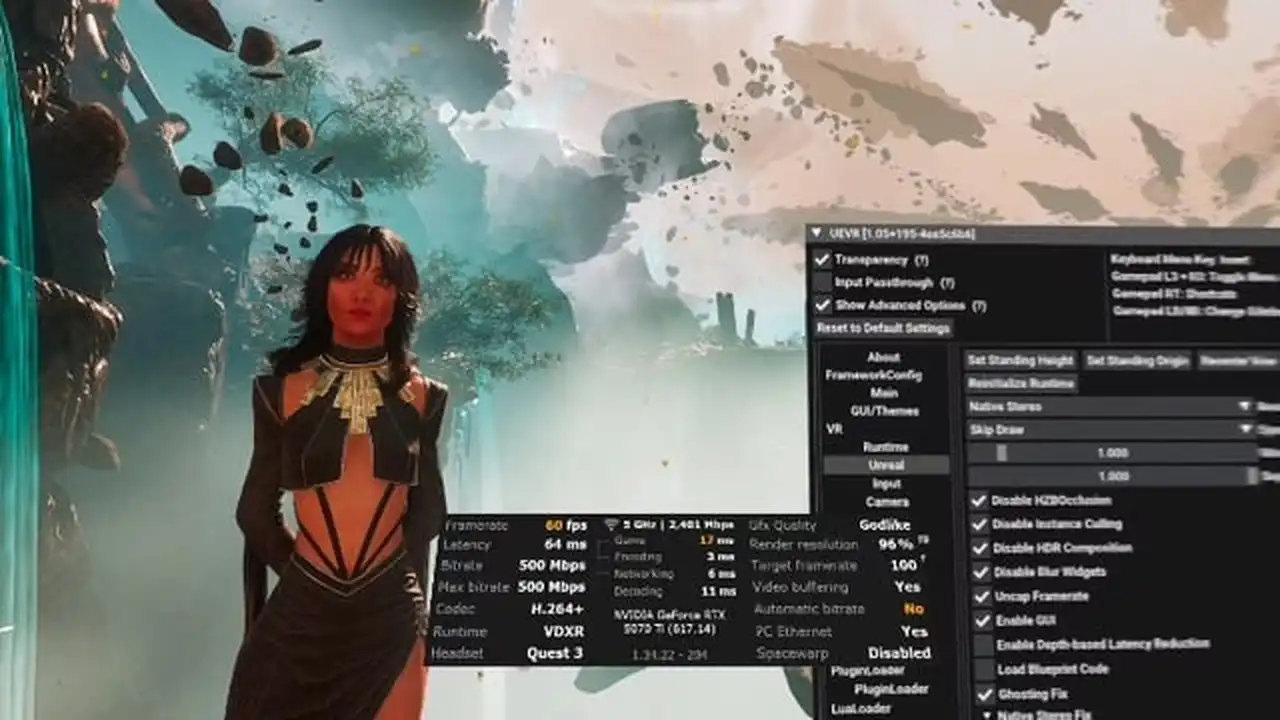
In Clair Obscur: Expedition 33, Noniv reported roughly 70% more FPS than Native Stereo at the same settings. The same setup also removed mismatched fog, lighting and shadows that sometimes appeared in only one eye.
That result is not a general UEVR benchmark. The contributor tested one game on Quest 3 using Direct3D 12 and OpenXR through Virtual Desktop VDXR.
A performance experiment found an accessibility audience
The fork was built for performance and stereo-rendering problems, but the Reddit discussion quickly exposed another use case. Players with monocular vision pointed out that they already live without normal binocular depth, making the loss of stereoscopic 3D a very different tradeoff for them.
“Okay, so I’m blind in one eye. This is probably my VR mod of the year.”
That response appeared under the creator’s Reddit demonstration, along with other comments from players with partial or monocular vision. The reaction does not turn Mono into a universal accessibility solution, but it shows why a rendering option designed for speed may help a group of players for a completely different reason.
For those players, the appeal is straightforward: if binocular separation is not useful to them, rendering two distinct viewpoints can spend GPU time on a visual difference they may not perceive. Mono redirects that work while keeping head tracking, motion parallax and the headset’s surrounding field of view.
The build exists, but it is not official UEVR yet
As of September 25, pull request #442 remains open, mergeable and unmerged. The experimental Mono method is therefore not part of the official UEVR master branch yet.
Noniv has shared a development build for testing, but Fix Gaming Channel has not tested the fork. The contributor specifically lists Direct3D 11, OpenVR/SteamVR, 2D screen mode and canted-display headsets such as Valve Index and Pimax as untested.
The code compiling for those paths is not the same as verified gameplay, so the current claim should stay narrow: one contributor, one tested game and one experimental rendering mode with a promising performance result and an unexpected accessibility angle.
UEVR Mono Rendering Fork
Pull request opened: September 21, 2026 UTC
Public Reddit demonstration: September 23, 2026
Contributor: Noniv
Status: Experimental open pull request; not merged into official UEVR
Verified test: Quest 3, Direct3D 12, OpenXR/VDXR, Clair Obscur: Expedition 33
Project page: GitHub pull request #442
Related Reading
GoldenEye 007 Is Now Playable in Native OpenXR VR Through GEVR
PlayDOOM Turns a Reddit Post Into a Complete Freedoom Campaign
33 Years Later, One of Robbo’s Original DOS Programmers Brought It to Playdate
Written by Ronny Fiksdahl, Founder & Editor-in-Chief of Fix Gaming Channel.
Send interview pitches, corrections, tips, or developer stories to contact@fixgamingchannel.com.
Support independent games coverage on Ko-fi.