The horn fires one portal, the tail fires the other, and the whole game fits inside 12.5 KB
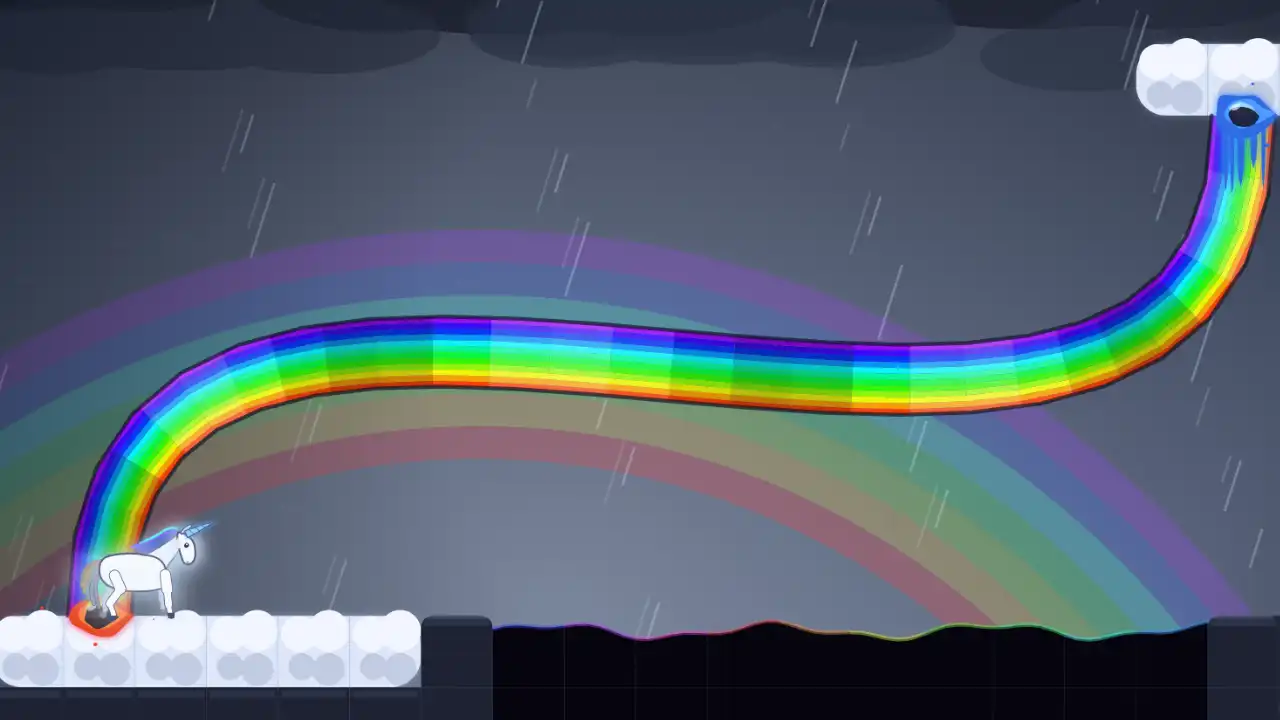
Rainwormhole is a free browser puzzle game built for js13kGames 2026, packing 19 puzzle rooms, code-drawn art, synthesized audio, and two rainbow portals into a current 12,804-byte ZIP.
The idea is simple enough to explain in one sentence: the unicorn’s horn fires the cold portal, while her tail fires the warm one. The constraint is what makes it interesting. The current public source contains 19 rooms, and the project’s repository history shows the entry was accepted into js13kGames on September 13, 2026.
It sits in the same strange technical corner as PlayDOOM running a complete 32-map Freedoom campaign inside Reddit: the limitation is not hidden behind the project. The limitation is the reason the project exists.
Want more strange little game projects like Rainwormhole?
Get more game features, reviews, interviews, indie coverage, and unusual gaming projects from Fix Gaming Channel.
Join Our Newsletter
Stay updated with the latest interviews, previews, and indie gaming news.
Two portals, one unicorn
Most portal games let you aim both ends wherever you want. Rainwormhole does not. The horn and tail each have their own firing arc, and those arcs do not overlap. In practice, placing both ends of the wormhole often means physically turning the unicorn around before taking the second shot.
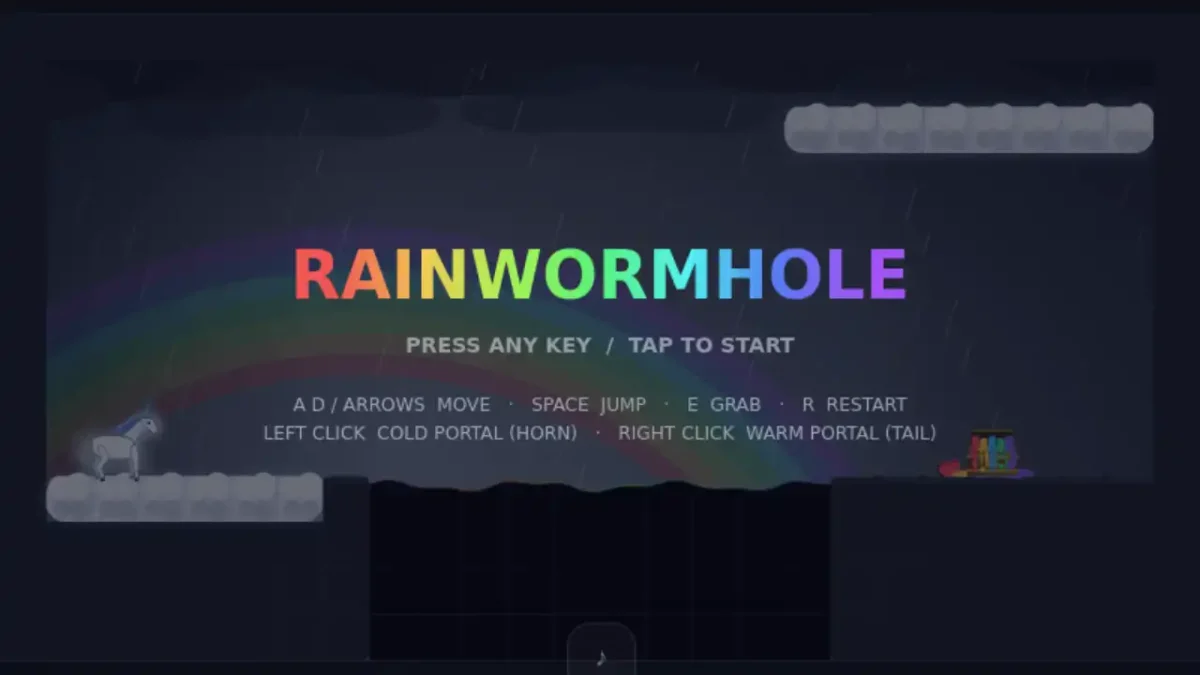
Portals stick to cloud tiles but are rejected by stone. Momentum carries through the wormhole, with each transit multiplying speed by 1.12 until the game’s cap is reached. Later rooms add cubes, buttons, gates, anvils, prism curtains, black ink, shades, lasers, and receivers. Cubes can even block a laser while being carried.
The current build is smaller than the README says
There is an important documentation wrinkle. The project README still describes a 21-level, 12,878-byte final submission. The files currently on the repository’s main branch no longer match those numbers: the downloadable Rainwormhole.zip is 12,804 bytes, and the current source contains 19 level definitions.
The repository history shows that a 21-level build did exist on September 13 before later changes. Rather than mix those versions together, we are using the current public-file figures here: 19 rooms in a 12,804-byte archive.
No external art files, no recorded soundtrack
The size limit is not being met by hiding a folder of assets somewhere else. According to the project documentation, every pixel is drawn in code and the sound effects are synthesized at runtime. The build process uses Terser, Roadroller, and Zopfli to squeeze the finished HTML into the competition archive.
That makes the tiny file size part of the design rather than a trivia number. It has some of the same appeal as Eridin, where a Nintendo e-Reader printing problem is shaping how the game itself is being built. The technical restriction pushes the project in a direction a normal production probably would not take.
The developer tested the weird parts
The repository is unusually detailed about verification. Documentation for the earlier 21-level build records 87,588 portal transitions scanned across valid portal pairs, offsets, and entry speeds, with none leaving the player embedded in a wall or outside the map. Scripted solutions were also used to test most of those rooms.
Those tests found two engine bugs that ordinary play had missed, including a jump rule that accidentally killed upward portal momentum and an entry window that could let a neighboring floor tile catch the player. For a game built under a severe size limit, that level of documentation is almost as interesting as the compression itself.
One accessibility note
The rainbow tube uses counter-phase contrast that inverts 7.5 times per second. The developer documents the effect against photosensitivity guidance and keeps its amplitude limited, but photosensitive players should still be aware of the flashing before playing. The README and current source comments do not agree on the exact measured flashing-area percentage, so we are not presenting one figure as definitive.
Play it in the browser
The official Rainwormhole browser build is available here. Desktop controls use the keyboard and mouse, while the game also includes on-screen mobile controls. The public repository contains the source, packed build, archive, level tools, and technical notes.
This is sourced spotlight coverage rather than a scored review. The interesting part is not simply that somebody made a portal puzzler with a unicorn. It is that the whole thing has been forced through a file-size ceiling small enough to make every sound, animation, level, and line of code compete for space.
Rainwormhole
Release: September 13, 2026 — js13kGames entry accepted
Genre: 2D puzzle platformer
Developer / Publisher: cuneytinann
Platforms: Web browser — official build
Related Reading
PlayDOOM Turns a Reddit Post Into a Complete Freedoom Campaign
33 Years Later, One of Robbo’s Original DOS Programmers Brought It to Playdate
A Printer Problem Is Why This New GBA e-Reader Game Is Being Built for PC Too
Written by Ronny Fiksdahl, Founder & Editor-in-Chief of Fix Gaming Channel.
Send interview pitches, corrections, tips, or developer stories to contact@fixgamingchannel.com.
Support independent games coverage on Ko-fi.