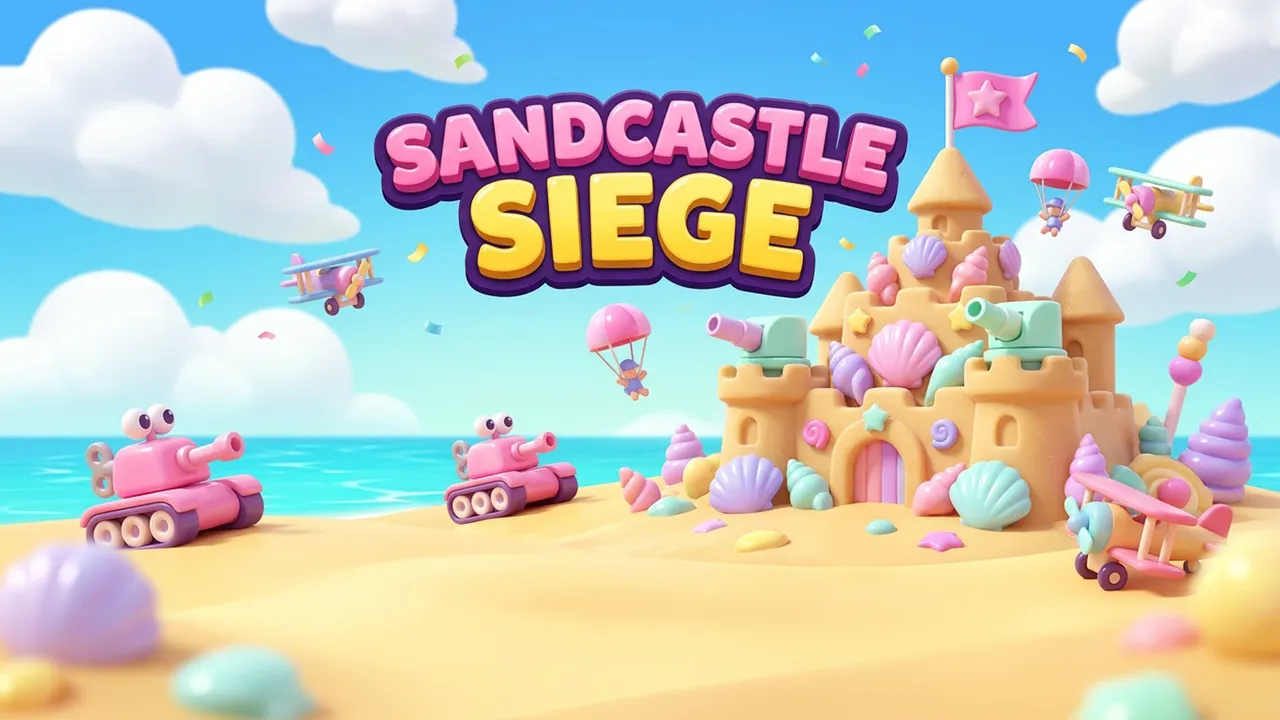
A fixed beach shooter becomes a 360-degree battle against toys
Aydın Polat on transforming an arcade memory into a colorful mobile defense game, and what a three-person team learned from testing on real phones.
After reading our Stelline developer story, Aydın Polat, creator of Sandcastle Siege, sent us this first-person account. Aydın confirmed the game was made by a three-person team rather than entirely alone. His story appears below in his own words.
Sandcastle Siege Official Trailer
Watch the official trailer (MP4)
More stories from the people making games
Subscribe for indie developer stories, interviews, reviews, and gaming news.
Join Our Newsletter
Stay updated with the latest interviews, previews, and indie gaming news.
The toy army that came up behind me
The idea for Sandcastle Siege started with an old PC shooter, not a design document: you sit in a fixed gun emplacement on a beach and hold off an invasion: tanks rolling out of the sea, planes overhead, soldiers running up the sand. No moving, no base building, just you, a gun and a wave that keeps getting bigger. I wanted that feeling on a phone, but I didn’t want war. So the army became toys.
That one decision changed everything. Wind-up tanks with a key turning on their back. Rubber-duck-yellow landing craft. Paratroopers floating down on candy-striped chutes. The bunker became a sandcastle on a tiny beach island, and the gun became a turret that fires confetti, jelly and homing fireworks. Suddenly it was something you could show a kid and a grown-up arcade fan at the same time.
Turning the camera around
The first version looked straight out to sea, like the game I remembered. It worked, but it felt flat on a phone. The moment the game really started to feel like the thing in my head was when I let the turret rotate a full 360 degrees and moved the castle to the middle of the island.
That created a new problem immediately: players can’t see behind themselves. Enemies were hitting the castle from off-screen and people had no idea why their health was dropping. I added a small radar in the corner, arrows on the screen edge pointing at threats, and a red flash on the side you’re being hit from. I deliberately kept text out of it. A flash is faster to read than a word when you’re mid-fight.
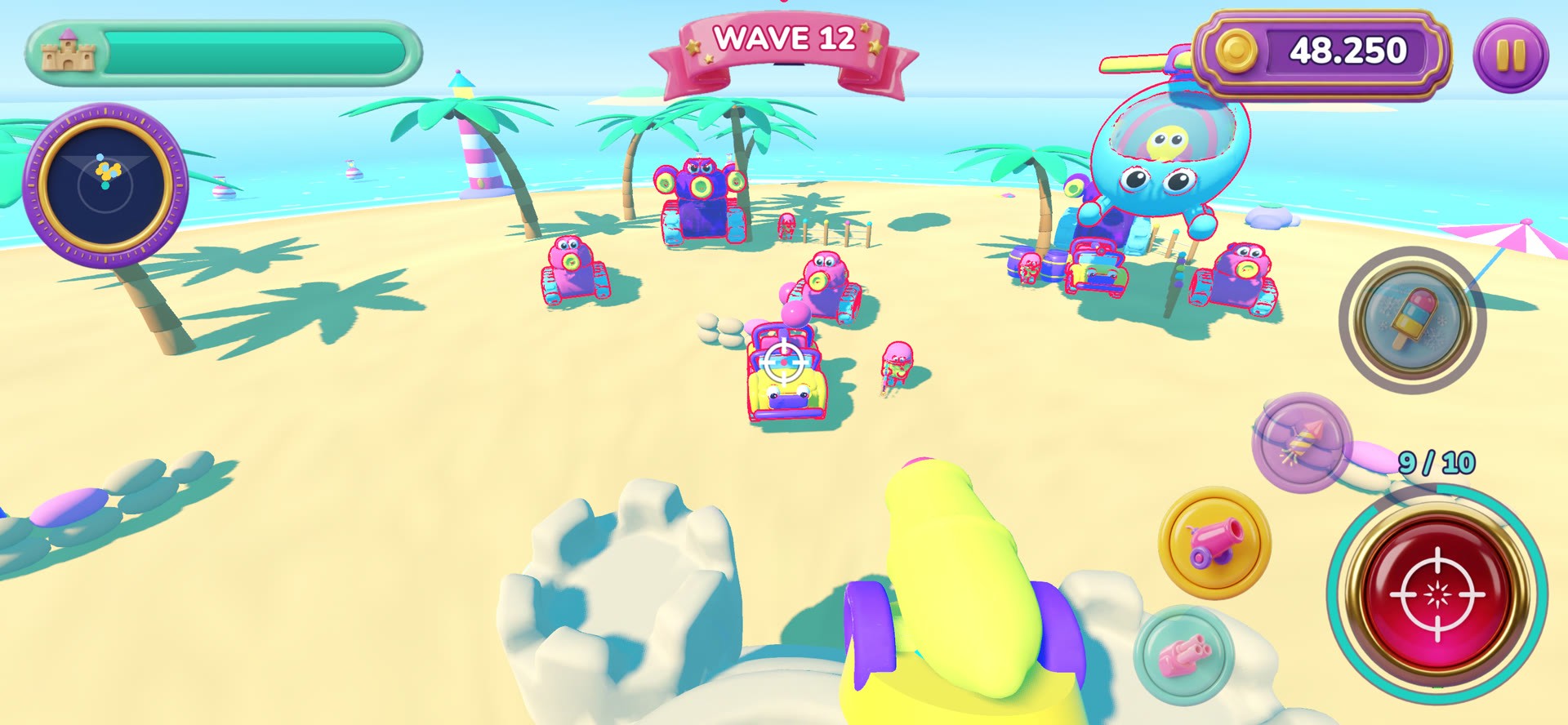
A toy army approaches the beach during Wave 12. Credit: Sandcastle Siege team.
Then I turned that weakness into a boss. The Gummy Kraken dives under the island and resurfaces somewhere around the castle, very often right behind you, and spits ink that smears across your screen. It lands at wave 25, after the game has spent 24 waves teaching you to watch the front.
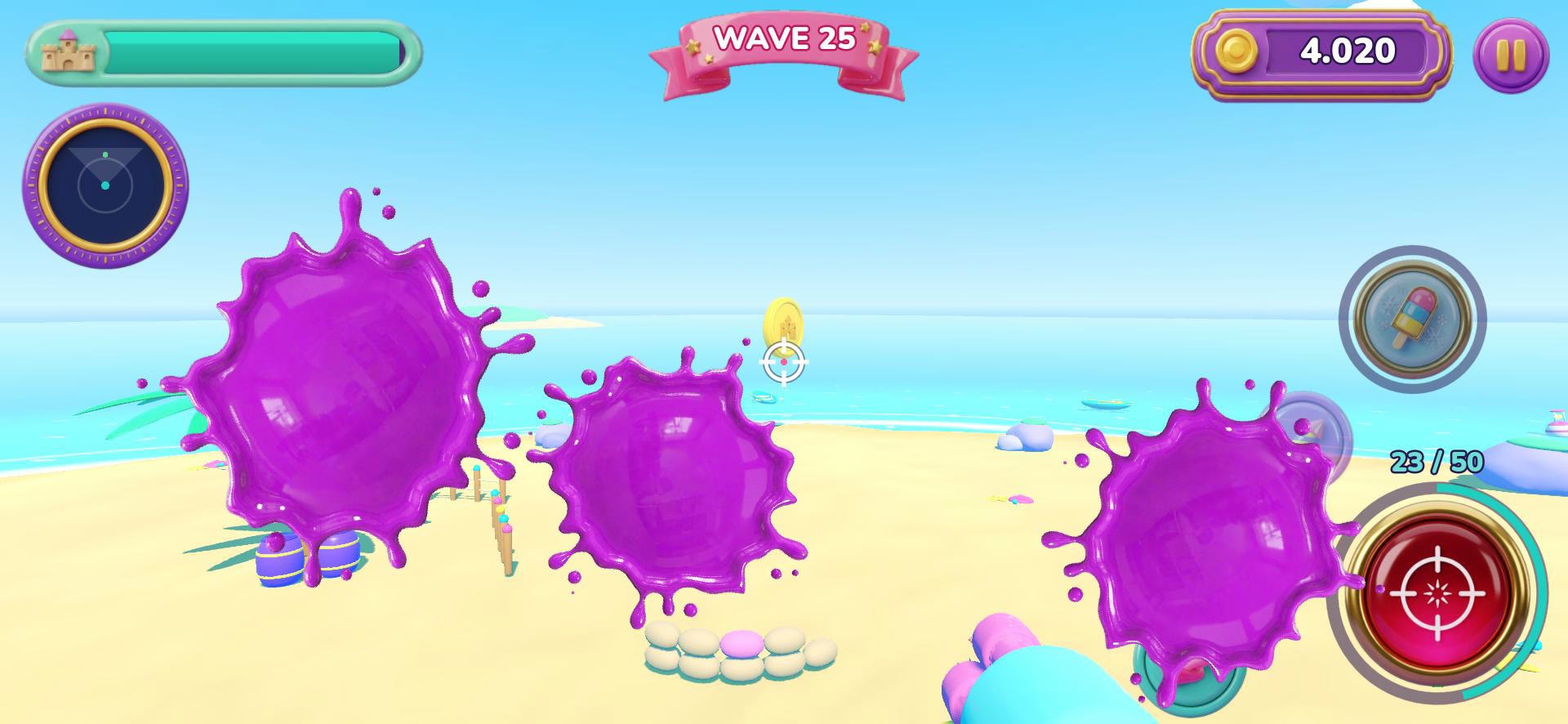
The Gummy Kraken’s ink attack obscures the screen during Wave 25. Credit: Sandcastle Siege team.
Things players will never see
A lot of the work was throwing things away.
The first batch of enemy models was made of simple stacked shapes. On a monitor they looked fine. On a phone, next to the art style I was aiming for, they looked cheap, so they were all rebuilt with soft, rounded, vinyl-toy proportions. The mecha crab boss became the quality bar every other unit had to match.
Enemy outlines were another reversal. I gave every enemy a bright outline so they’d be easy to spot. It turned out the outline on a small, distant toy hid what the toy actually was; you just saw a glowing blob. Now only close enemies, attackers and incoming bombs get a blinking red outline, and far-away toys are allowed to just look like toys.
Ammo was the same. The first magazine sizes were too stingy and the game felt like it was punishing you for shooting, which is the opposite of what an arcade shooter should do. They went up a lot.
The menus went through several rounds too. Every button and card is a piece of painted art, and early versions had ugly green fringes around the edges from how they were cut out. Fixing that properly meant rebuilding the way the art was processed, then checking every piece zoomed in over a light background before shipping.
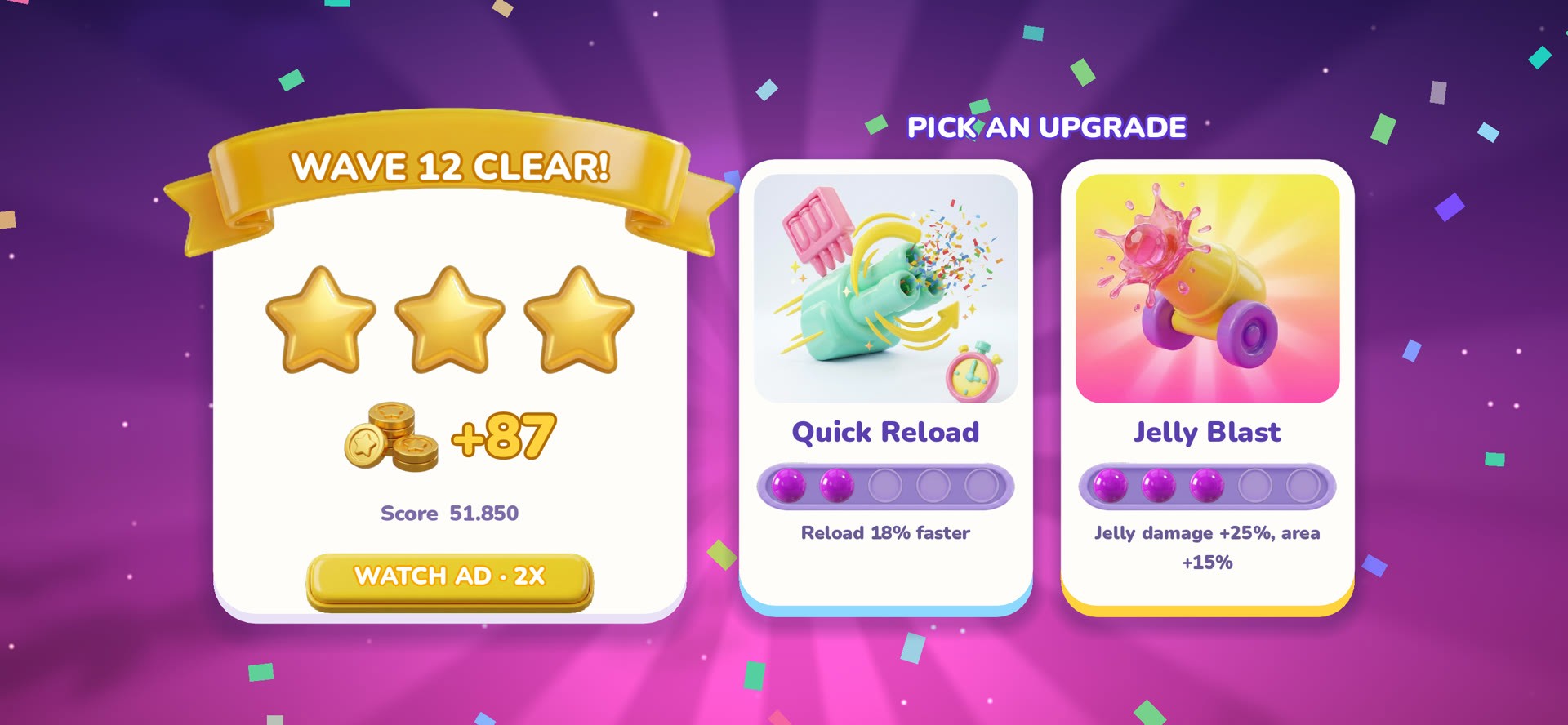
Players choose between Quick Reload and Jelly Blast after clearing a wave. Credit: Sandcastle Siege team.
Bosses, and then two at once
There’s a boss every five waves: a wind-up mega robot, an inflatable battleship firing cannonball broadsides you can shoot down, a candy blimp, the mecha crab, the kraken, a candy dragon whose fire sets your castle burning, and Captain Duck, who sits out at sea launching bomb ducklings at you. One small rule made them feel much bigger: the boss only arrives after every regular enemy of that wave is gone, with a short fly-in shot, so it never gets lost in the crowd.
After all seven are beaten, the boss waves start sending two different bosses together from different sides. Balancing that was the hardest part of the 360° design, because the whole point is that you can’t watch both.
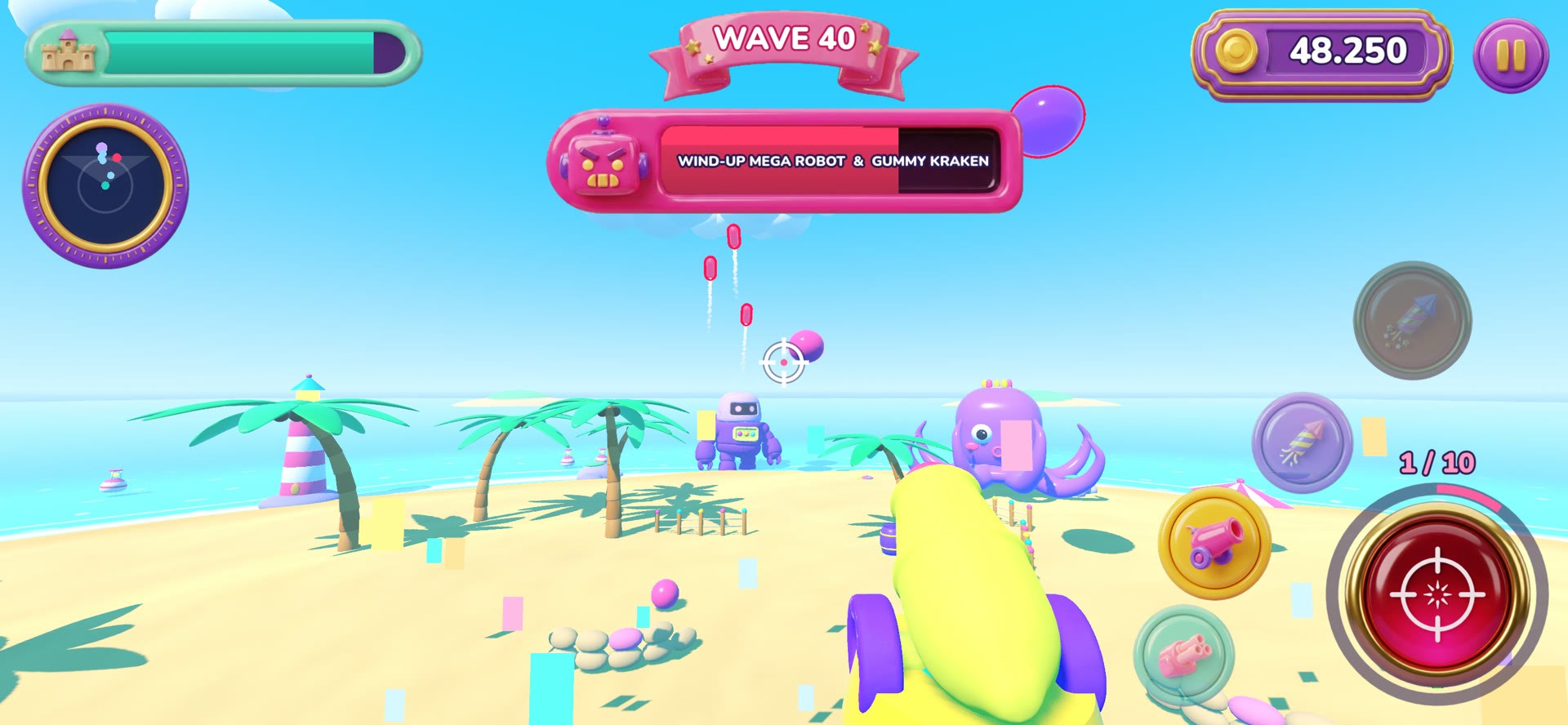
A later wave brings the Wind-Up Mega Robot and Gummy Kraken together. Credit: Sandcastle Siege team.
Shipping to two stores
Getting onto both iOS and Android taught me more than I expected. The iOS builds are made on cloud build machines and go straight to TestFlight, which is how every change was play-tested on a real iPhone. The app’s package name was changed right before the first Google Play upload, because once it’s live you can never change it. And a store requirement update landed during development, so the Android build had to move to the newest target version before release.
I also made one choice about ads that I’m glad about: there are no interstitial ads at all until you beat the first boss. Rewarded ads are there from the start if you want a revive or double coins, but nobody gets an ad pushed in their face in their first few minutes.
What I learned
The game you have in your head is not the game. The old beach shooter was a starting point, but almost every part of Sandcastle Siege that works came from watching it fail on a real phone and changing it: the camera, the outlines, the ammo, the bosses. If I had kept the first version because it matched the picture in my head, it would be a much worse game.
Sandcastle Siege is free on the App Store and Google Play, and it plays fully offline.
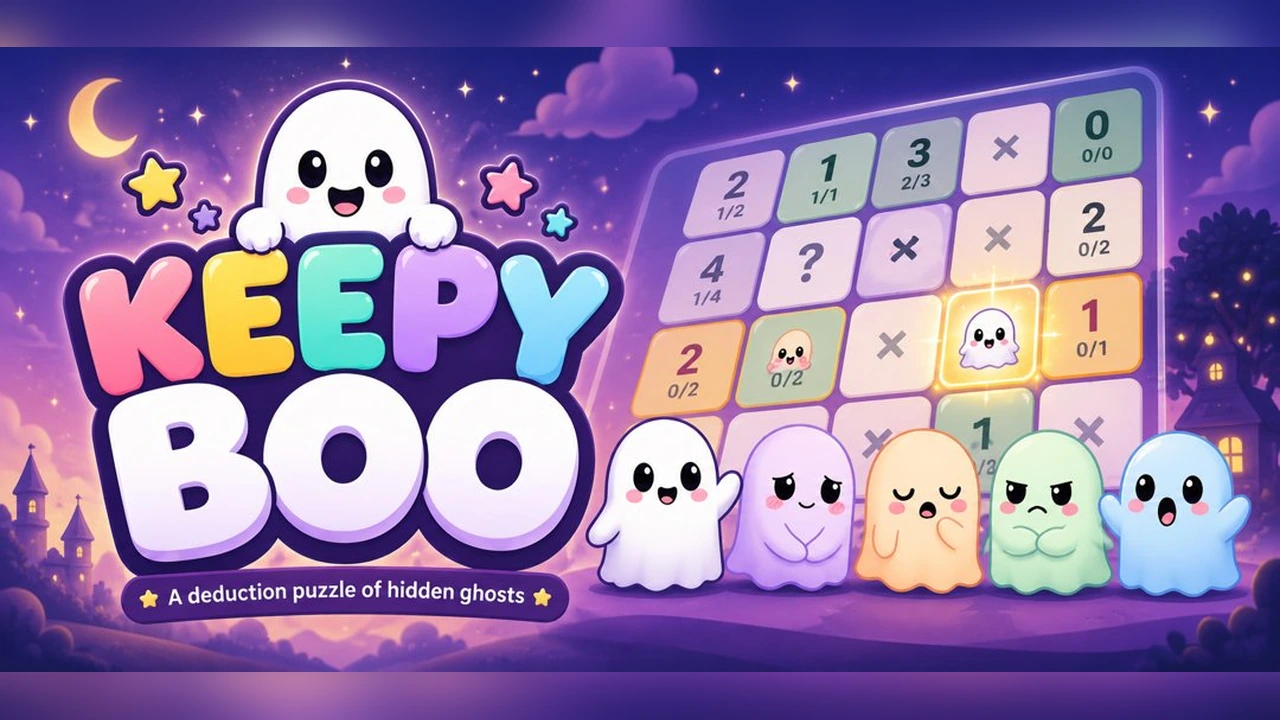
Fix Gaming Channel: This developer-submitted account has been formatted for Fix Stories without rewriting Aydın’s personal account. For more stories about mobile-game design, read how KEEPYBOO removed guessing from its puzzles.
Sandcastle Siege
Release: Available now
Genre: Arcade shooter / turret defense
Developer / Publisher: Creator Aydın Polat and a three-person team; Google Play lists Poze Tech, while Apple lists Sukru Polat
Platforms: iOS — App Store · Android — Google Play
Related Reading
Fix Stories: One Swift Engine, Two Phones — How Stelline Came to Android
Fix Stories: KEEPYBOO and the No-Guessing Puzzle Promise
Fix Stories: I Built an iPhone Duo Game Without Owning the Phone
Story written by Aydın Polat, creator of Sandcastle Siege, developed by a team of three.
Edited for publication by Ronny Fiksdahl, Founder & Editor-in-Chief of Fix Gaming Channel.
Send interview pitches, corrections, tips, or developer stories to contact@fixgamingchannel.com.
Support independent games coverage on Ko-fi.