Steam just set a new all-time concurrent user record — and the “online” number isn’t the full story
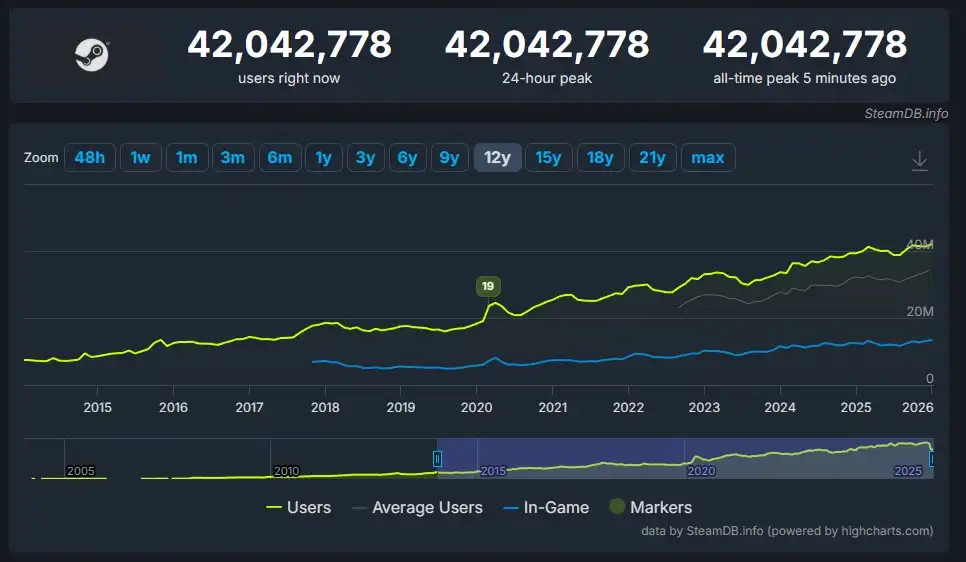
January 13, 2026 — Steam has started the year with a fresh platform milestone: 42,042,778 concurrent users online, as tracked by SteamDB (set on January 11, 2026). That’s the biggest “users online at once” number Steam has ever posted on public trackers — and it continues a multi-year climb that keeps resetting the ceiling.
Before the number gets thrown around without context, it’s worth one simple clarification: “concurrent users online” is not the same as “people playing games right now.” Steam’s online count includes everyone logged in — browsing the store, updating libraries, chatting, idling — while only a portion of that total is actively in-game at any moment. For more Steam platform context, read our Steam storefront legal case coverage and our look at what PC gaming might look like without Steam.
Steam’s concurrent user chart (SteamDB)
Join Our Newsletter
Stay updated with the latest interviews, previews, and indie gaming news from Fix Gaming Channel.
What “concurrent users” actually measures
A concurrent user record is basically Steam’s busiest moment: the highest number of accounts logged in at the same time. It’s a useful health check for the platform — but it’s not a direct “how many people are playing games” headline.
- Online: logged into Steam (store, library, downloads, chat, idle, etc.).
- In-game: actively running a game via Steam (always a smaller subset).
SteamDB vs Valve’s own tracker
If you compare public trackers, you’ll sometimes see tiny differences depending on update timing and methodology. SteamDB’s all-time peak is listed as 42,042,778, while Valve’s Steam stats page shows a peak of 42,042,323 for the recent 48-hour window. The important part is the headline itself: Steam has crossed 42 million concurrent users.
Sources: SteamDB (Steam charts), Steam & Game Stats (Valve).
Is 50 million next?
Fifty million concurrent users is the next “round-number” milestone people will point to — but it’s not close. Even with Steam’s steady growth, that’s a multi-year step from 42M, and it would likely require the same mix that drives spikes now: big global releases, seasonal sales, and the platform’s ongoing expansion across regions and devices.
Why this matters (even if you ignore the headline number)
For developers and publishers, Steam’s rising baseline means more eyes, more wishlists, and tougher competition at the same time. For players, it’s a reminder that PC gaming isn’t “shrinking” — it’s consolidating around a storefront that keeps getting bigger.
Related Reading
Written by Ronny Fiksdahl, Founder & Editor-in-Chief at Fix Gaming Channel.
Send interview pitches, corrections, tips, or developer stories to contact@fixgamingchannel.com.
Support independent games coverage on Ko-fi.