Are We All Working the Same Shift Again?
Gas station games are not new. But when the same night shift, the same routine tasks, the same strange customers, and the same lonely roadside horror setup keeps returning, it starts to feel like a pattern worth tracking.
This is Part 3 of The Gas Station Files, a Fix Gaming Channel editorial series looking at repeated gas station horror setups, marketplace asset patterns, and the growing night-shift formula appearing across Steam.
The first article looked at Roadside Research, Before Exit: Gas Station, and The Legacy through a visual comparison lens. The second article, Let’s Revisit That Gas Station, continued the discussion after another familiar roadside setup appeared.
Now the topic has moved beyond one building. It is not only about whether one asset pack has been used more than once. It is about a wider Steam trend built around the same core fantasy: get hired for a night shift, clean the place, serve customers, refill shelves, notice something is wrong, and survive long enough to finish the shift.
As a reviewer, that is where the problem starts. I can forgive marketplace assets. I can forgive familiar genre ideas. I can forgive small-team shortcuts when the final game has personality. What is harder to forgive is when I recognize the whole shift before it starts.
The same counter. The same chores. The same strange customer. The same “finish the night” rhythm.
At that point, the question is no longer only whether something is allowed. The question is whether it is still interesting.
HERROR: Gas Station Case Trailer
Get more game features, reviews, interviews, indie coverage, and industry pattern pieces from Fix Gaming Channel.
Join Our Newsletter
Stay updated with the latest interviews, previews, and indie gaming news.
The straight gas station baseline
Gas Station Simulator remains the obvious baseline. It is not part of the horror pile. It is the straight business-sim version: buy an abandoned gas station, restore it, expand it, and keep customers moving.
That game makes sense because the gas station is the whole management system. You renovate it, upgrade it, run it, and build around it. The location is not just a spooky backdrop. It is the game.
That distinction matters when looking at the newer wave. A gas station can be a strong setting. But if every new horror version starts with the same shift, same chores, and same strange-customer setup, the next question becomes simple: what is this game doing that the others are not?
Roadside Research has the clearer twist
Roadside Research is still one of the stronger examples because it changes the role completely. You are not just a tired employee stuck on another creepy shift. You are an alien working undercover at a human gas station while preparing for an invasion.
That gives the game a reason to exist beyond the shop counter. Stocking shelves and dealing with customers becomes part of a disguise. The gas station is not only a place to clean. It is cover for alien research.
That is why Roadside Research stood out when we covered it as Game of the Week #12. It still uses the now-familiar roadside setup, but the co-op alien angle gives the loop its own identity.
Before Exit: Gas Station and the finish-the-shift formula
Before Exit: Gas Station leans directly into the closing-shift idea. You clean the store, take care of the last customers, make sure everything is finished, and try to avoid whatever happens when something is wrong.
That setup works because it turns normal work into paranoia. Did you miss something? Did the lights look like that before? Was that customer normal? Is the store changing, or are you just staring at the same room too long?
It is also where the wider formula becomes clear. The ordinary job is the hook. The routine becomes the horror. The player is trapped between boring work and supernatural pressure.
HERROR: Gas Station Case joins the night shift
[HERROR] Gas Station Case is listed for 2026 and describes itself as detective horror about a gas station night shift far from the city. The Steam page mentions refuelling cars, serving customers, keeping the station running, investigating disappearances, and being careful because not all visitors are human.
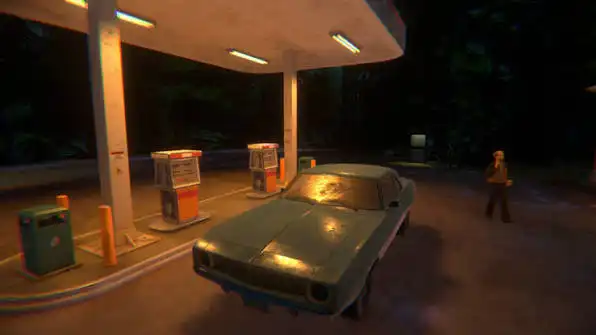
HERROR: Gas Station Case uses the familiar gas station night-shift setup.
That puts it straight into the same conversation. I am not saying it uses the exact same asset pack. I am saying the setup is now familiar before the game even releases.
Gas station. Night shift. Customers. Disappearances. Visitors who may not be human.
At some point, the question is no longer only “is this asset reuse?” The question becomes: why are so many games using the same work-shift horror skeleton?
The same shift keeps spreading
It is not only one or two games anymore. The Shift uses the isolated gas station cashier setup. Shift At Midnight turns the idea into co-op detective horror, with customers who may only be pretending to be human. The Gas Station and The Gas Station: Graveyard Shift both lean into the same lonely work-shift horror space.
Some of these may turn out stronger than others. Shift At Midnight, for example, seems to have a clearer mechanic than another simple “work the counter and survive” setup. But the overlap is hard to ignore. The setting, the rhythm, and the player fantasy are becoming familiar before the game even starts.
The asset question is still there
The asset discussion is not going away. QuadArt’s Rural Gas Station environment is a real marketplace asset, described as a gas station environment around a forest with cars, a garage, props, goods, and more.
Our earlier visual comparison looked at why some scenes felt unusually familiar. That was a visual comparison only, not a legal claim and not proof of wrongdoing.
But it raised a fair creative question. If several games begin to look like the same roadside location, and several more begin to use the same night-shift horror structure, where does asset-assisted development end and asset-led game design begin?
That is the heart of The Gas Station Files.
QuadArt responds
Fix Gaming Channel contacted QuadArt, the creator of the Rural Gas Station asset, for comment on how marketplace environments are used across games.
In a reply to Fix Gaming Channel, QuadArt said the asset was created as a flexible location that could fit survival, exploration, or horror games. They also said they were surprised to see some developers build entire games around it.
“I was honestly surprised to see some developers build an entire game around it.”
QuadArt also pointed out that the same environment can feel different depending on how developers use lighting, weather, post-processing, sound, and gameplay.
“Different lighting, weather, post-processing, sound, and gameplay can make the same environment feel different.”
Their most important point may be the simplest:
“I’d rather play a fun game that uses familiar assets than a boring game with completely unique ones.”
That is hard to argue with. A familiar asset is not the real problem. A boring game is.
From a reviewer’s point of view, this is the line. The asset is not the crime. The question is whether the final game uses that asset to build something memorable, or whether the asset becomes the whole identity.
The musician problem
This is also why the topic bothers me personally. Coming from music, inspiration is normal. Shared influences are normal. Certain styles, chord progressions, and moods come back again and again.
But when the main riff sounds the same, the structure feels the same, and only the title changes, people notice.
Game assets are legal tools. They help small teams build faster. They can be part of good development. But creative identity still matters. If the player recognizes the whole idea before the game has done anything with it, the problem is not just visual familiarity. The problem is boredom.
Why the trend is getting bigger
PC Gamer also picked up on the wider “sinister convenience store simulator” wave, pointing to games that mix retail chores with horror, sci-fi, doppelgangers, and survival pressure.
That does not surprise me. The idea is easy to understand. Everyone knows what a late-night shop or gas station feels like. The lighting is harsh. The world outside is dark. Customers can feel strange. The work is repetitive. Horror fits naturally into that space.
The problem is that once a trend becomes easy to explain, it also becomes easy to copy.
That is where gas station horror sits right now. The setting is strong. The formula is visible. The next game needs more than another counter, another mop, another phone call, and another customer who might not be human.
So, what are the best gas station games for 2026?
If we are talking about games with a clear identity, Gas Station Simulator remains the proper business-sim baseline, while Roadside Research stands out because the alien co-op concept gives the setting a purpose beyond routine work.
If we are talking about the horror trend, Before Exit: Gas Station, The Shift, Shift At Midnight, The Gas Station, The Gas Station: Graveyard Shift, and [HERROR] Gas Station Case all belong in the same growing night-shift file.
Some may turn out good. Some may not. The point is not to dismiss them before release. The point is to document the pattern.
Because by now, the gas station is not just a location. It is becoming a genre shortcut.
And once players start recognizing the shift before they clock in, the real challenge for developers is simple:
Make this gas station feel like yours.
Related Reading
Gas-Station Visual Compare: Roadside Research × Before Exit (+ The Legacy cameo)
Let’s Revisit That Gas Station: Why This Same Roadside Setup Keeps Turning Up
Game of the Week #12: Roadside Research Hits 150K Wishlists
Written by Ronny Fiksdahl, Founder & Editor-in-Chief of Fix Gaming Channel.
Send interview pitches, corrections, tips, or developer stories to contact@fixgamingchannel.com.
Support independent games coverage on Ko-fi.