



A Desktop Luck Cat Built Around Korean Tradition
In this Fix Stories contribution, developer Lee Hee Sang of Noligo Games (HS Solution) shares the story behind Saju Friend, from Korean fortune traditions to pixel art, generated music and AI-assisted development.
Lee submitted this first-person account and six in-game screenshots for Fix Gaming Channel’s Fix Stories series. His account is presented below in his own words.
Saju Friend Trailer
Watch the Saju Friend trailer on Steam
First-Person Stories From Indie Developers
Get developer stories, interviews and independent gaming coverage from Fix Gaming Channel.
Join Our Newsletter
Stay updated with the latest interviews, previews, and indie gaming news.
Building Saju Friend Around Boknyang
A Cat in the Corner of the Screen
I made Saju Friend as a desktop game where Boknyang (복냥이), a pixel luck cat, lives in a corner of the screen while you work or study. The cat window can stay above other windows, let clicks pass through, and be resized one step at a time with the mouse wheel. The first desktop commit, dated 2 October 2026, already included today’s luck, fortune cookies, and a ported saju engine. The game went out on Steam on 5 November 2026, about five weeks after that first commit.

Boknyang sits on a cushion in a desktop corner, with a “Click me to play with luck” speech bubble.
Where the Name and the Tradition Come From
“Saju” (사주, four pillars) is the Korean way of reading a person’s birth year, month, day and hour as four pairs of characters. In Korea it is something people check casually, often around the new year, much like a horoscope column. The cat’s name is a small Korean pun: “bok” (복) means good fortune, and “nyang” (냥) is the sound a cat makes. So Boknyang is simply “the fortune cat.”
I did not want the game to read like a prediction service, so it carries the plain label “For entertainment only.” Bokjeon, the in-game coin, is not real money; it has no real-world value and cannot be purchased. The slots and scratch screens also state that no real money is used.
Alongside the saju engine, I added fortune cookies, tarot with the 22 Major Arcana cards and spreads of one, two, three or five cards, Western zodiac, Chinese zodiac, Maya, Celtic tree, numerology, omikuji, name compatibility, dice, slots, coin, scratch, and a small luck lab. The collection side has a 17-slot luck-play book and 63 catalog slots for cat outfits and room items. Ten of those are starting items and 53 can be bought with Bokjeon, at prices from 60 to 3,800. Korean instruments also appear in the soundtrack — gayageum, daegeum and haegeum tracks, plus a modern fusion piece built on a janggu drum pattern.
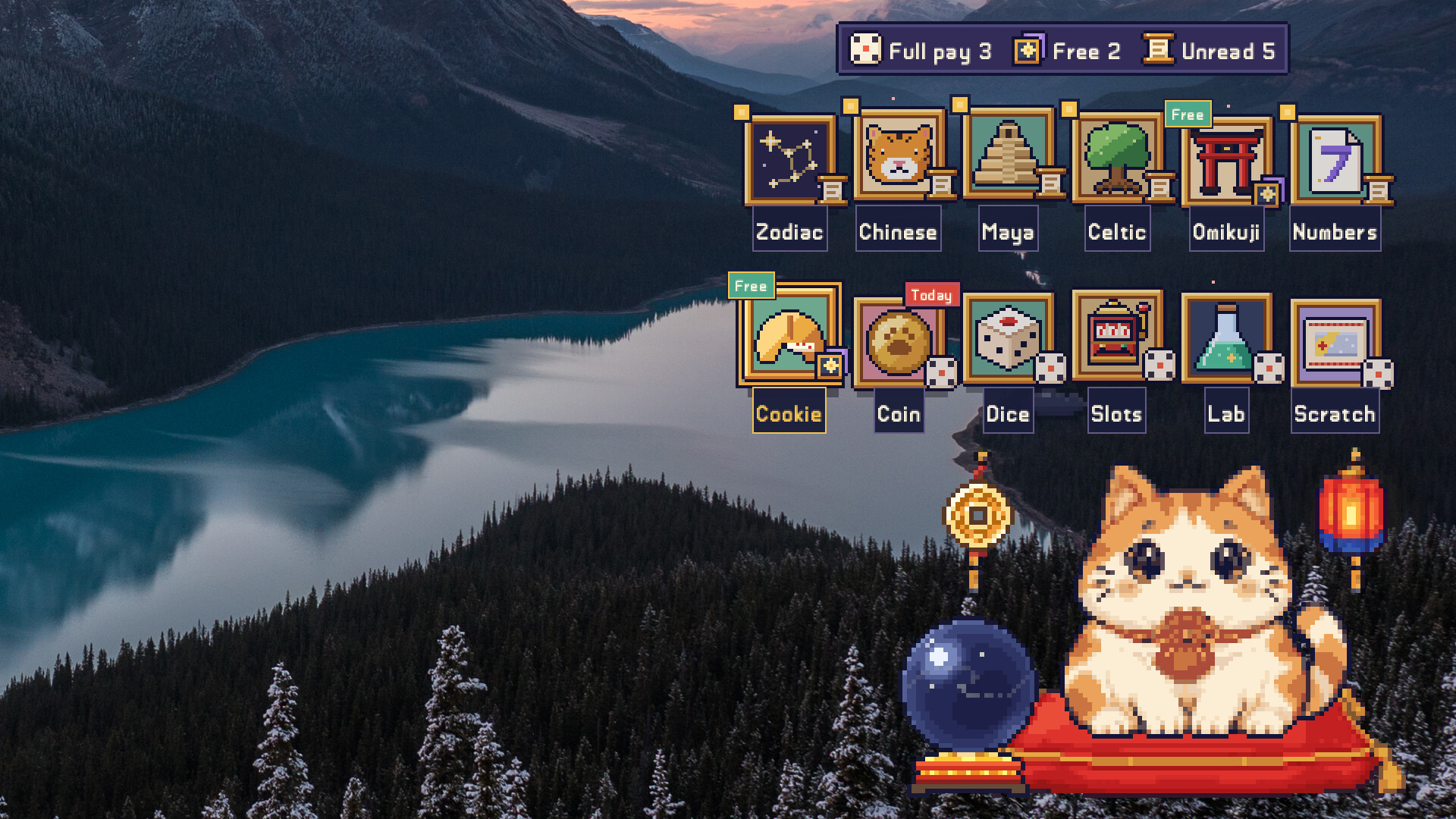
The play menu: Zodiac, Chinese, Maya, Celtic, Omikuji, Numbers, Cookie, Coin, Dice, Slots, Lab and Scratch.
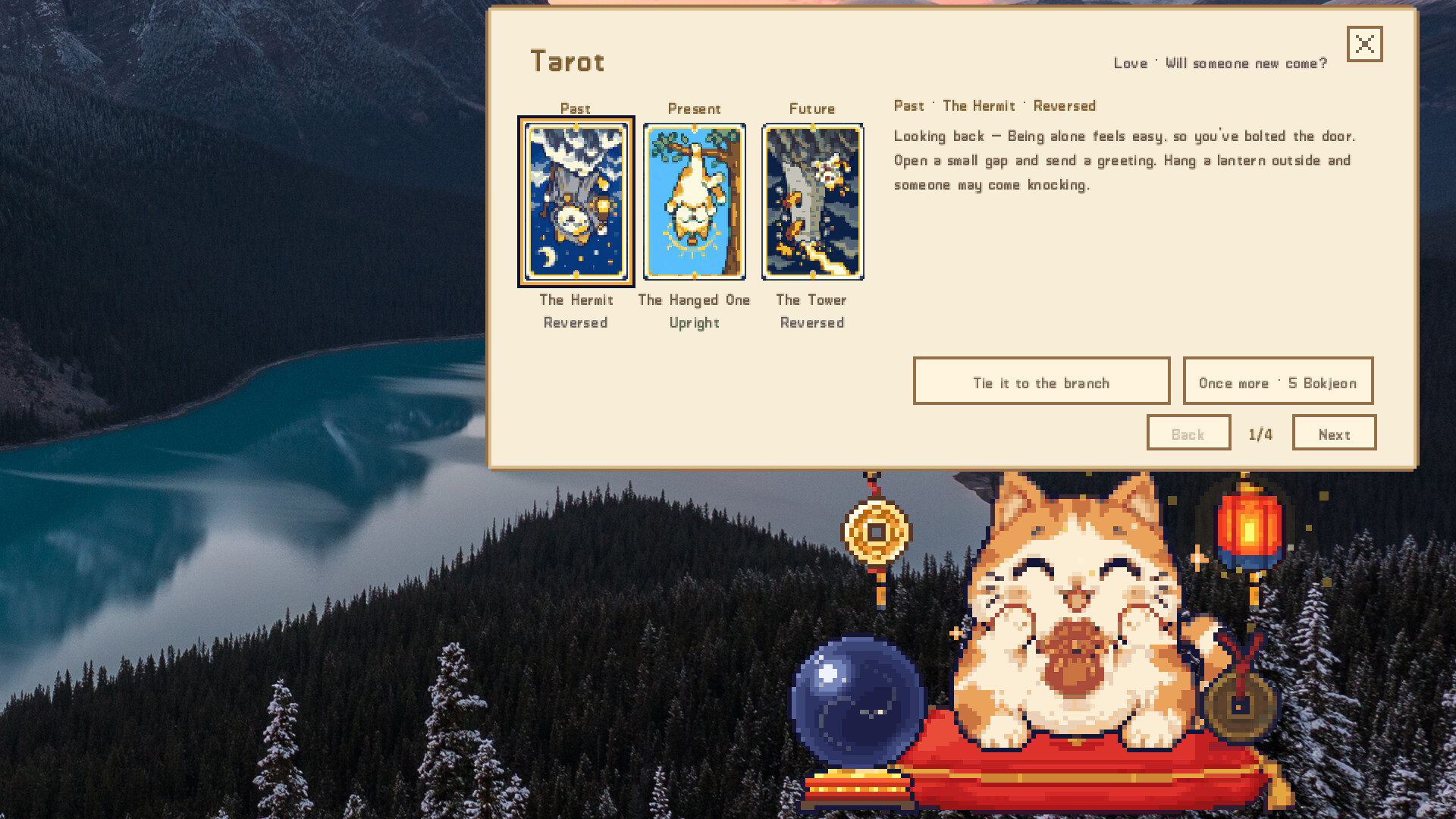
A three-card tarot spread — Past, Present and Future.
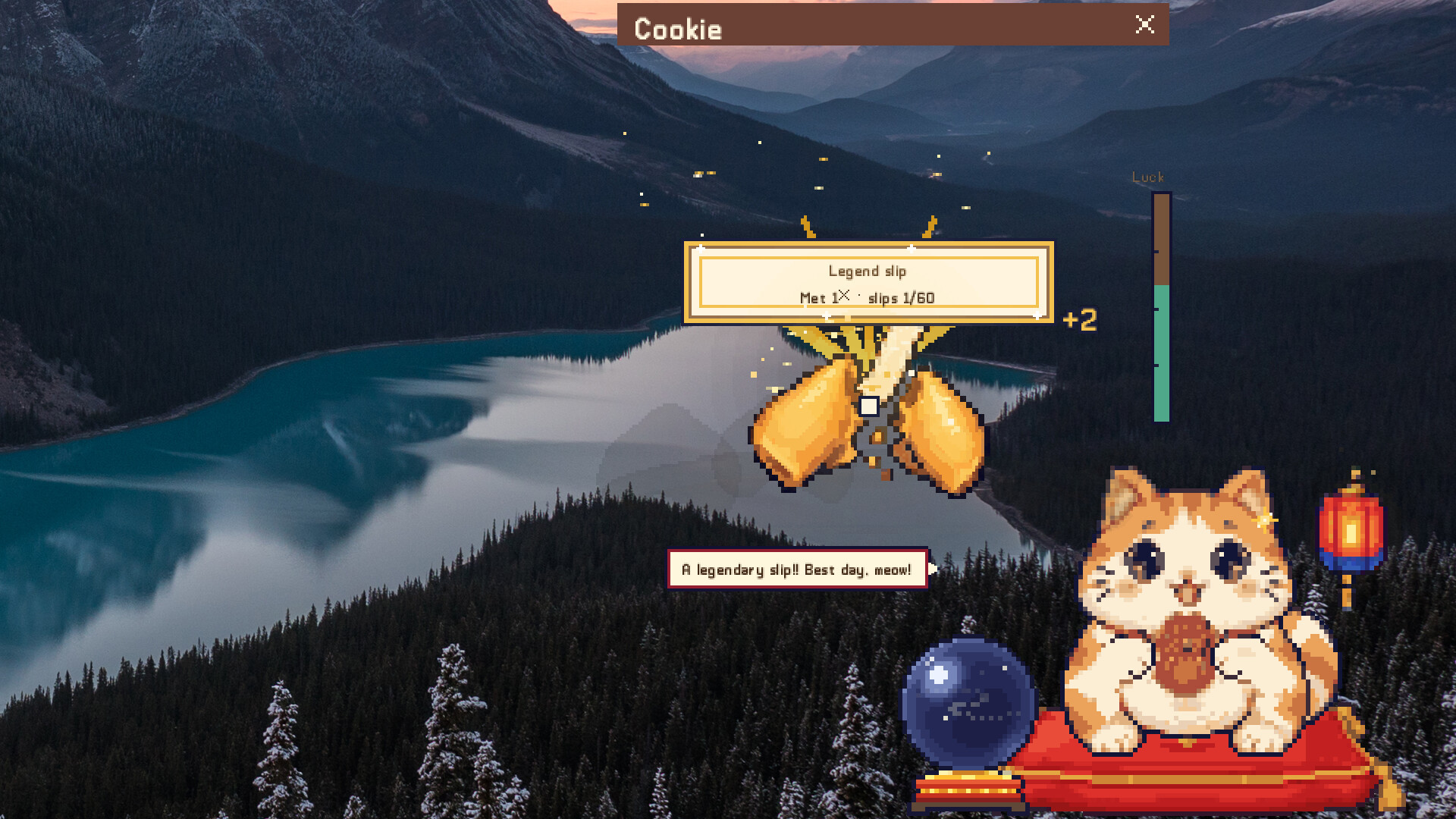
The fortune cookie window reveals a “Legend slip.”
A Focus Timer and Explicit Currency Rules
The focus timer has three lengths: 15, 25 and 50 minutes. Finishing them gives 3, 5 or 12 Bokjeon, for up to eight rewarded sessions a day. Quitting gives no reward and leaves Boknyang looking a little dejected. On 20 October I removed a trademarked name from the timer menu and kept generic wording instead.
Idle progress uses an “unki” (luck energy) orb. It fills one point per second while the game is running and can count up to two hours while it is closed. Coins do not pile up on their own: when the orb is full, you click to pop it and receive 12 Bokjeon and 12 plays. The text is translated into nine languages: Korean, English, Japanese, Spanish, Brazilian Portuguese, Russian, Ukrainian, Simplified Chinese and Traditional Chinese.
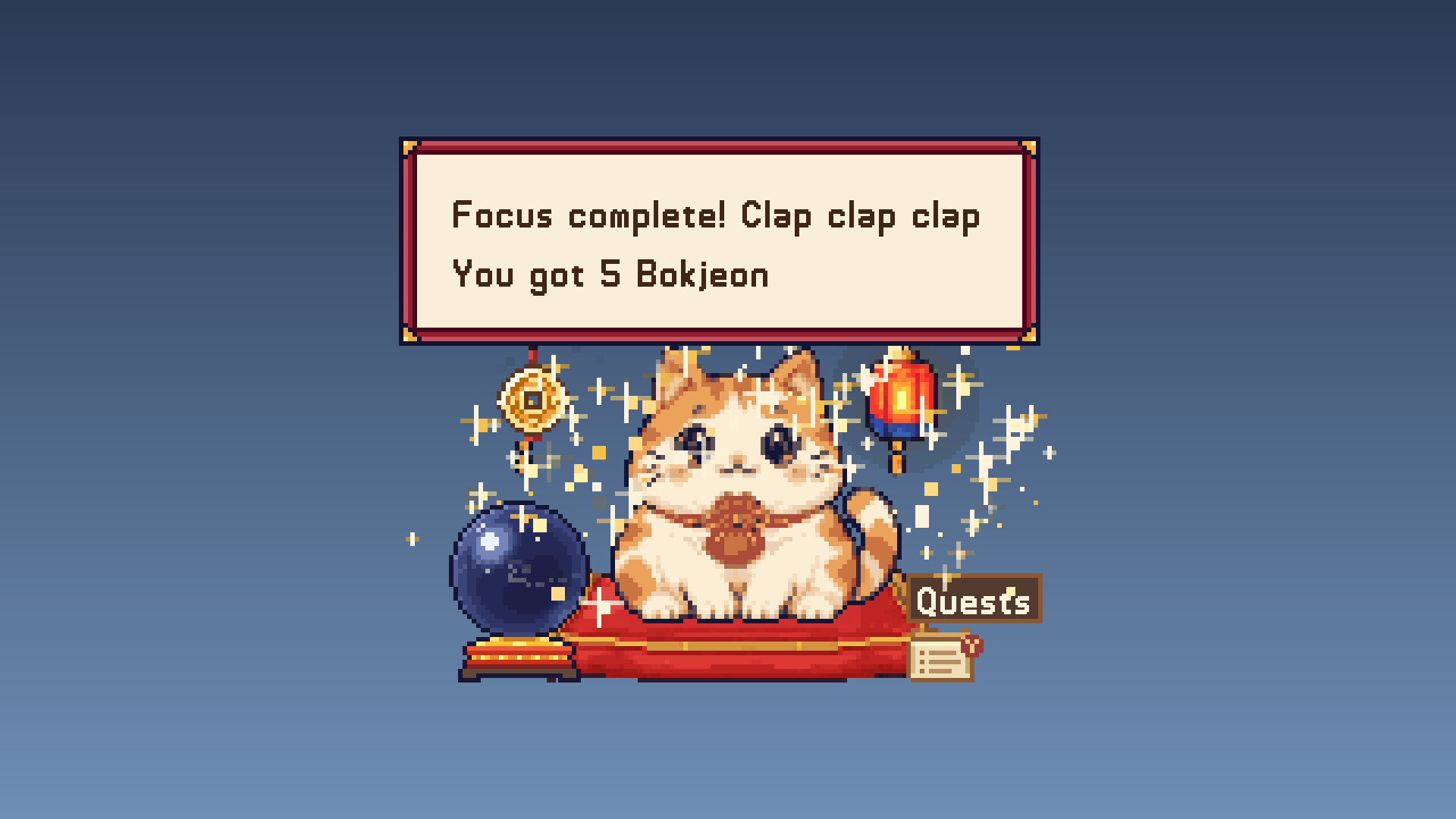
A finished focus session: “Focus complete!” and 5 Bokjeon.
Rebuilding the Pixels
The art uses a shared palette of cream, ivory, ochre, warm gold and brown, with dark brown outlines. On 17 October I standardized artwork that had been drawn at mixed 1x, 3x and 4x pixel scales onto a common 2x scale. A few exceptions stayed where legibility needed them — small selection graphics, zodiac animals, Maya stones, tarot results, and a 2x–3x–2x step while a coin is in the air.
Pixel work is done in Aseprite at the real source resolution, keeping editable .aseprite originals next to the PNG files the game uses. PixelLab is a generation aid, but its output is checked and cleaned in Aseprite rather than accepted after a resize or format conversion. Most of the 2D pixel art was first made with AI image tools and then retouched by a designer. On 2 November I remade the cat skins, six cushions, and the bok and lantern room items this way.
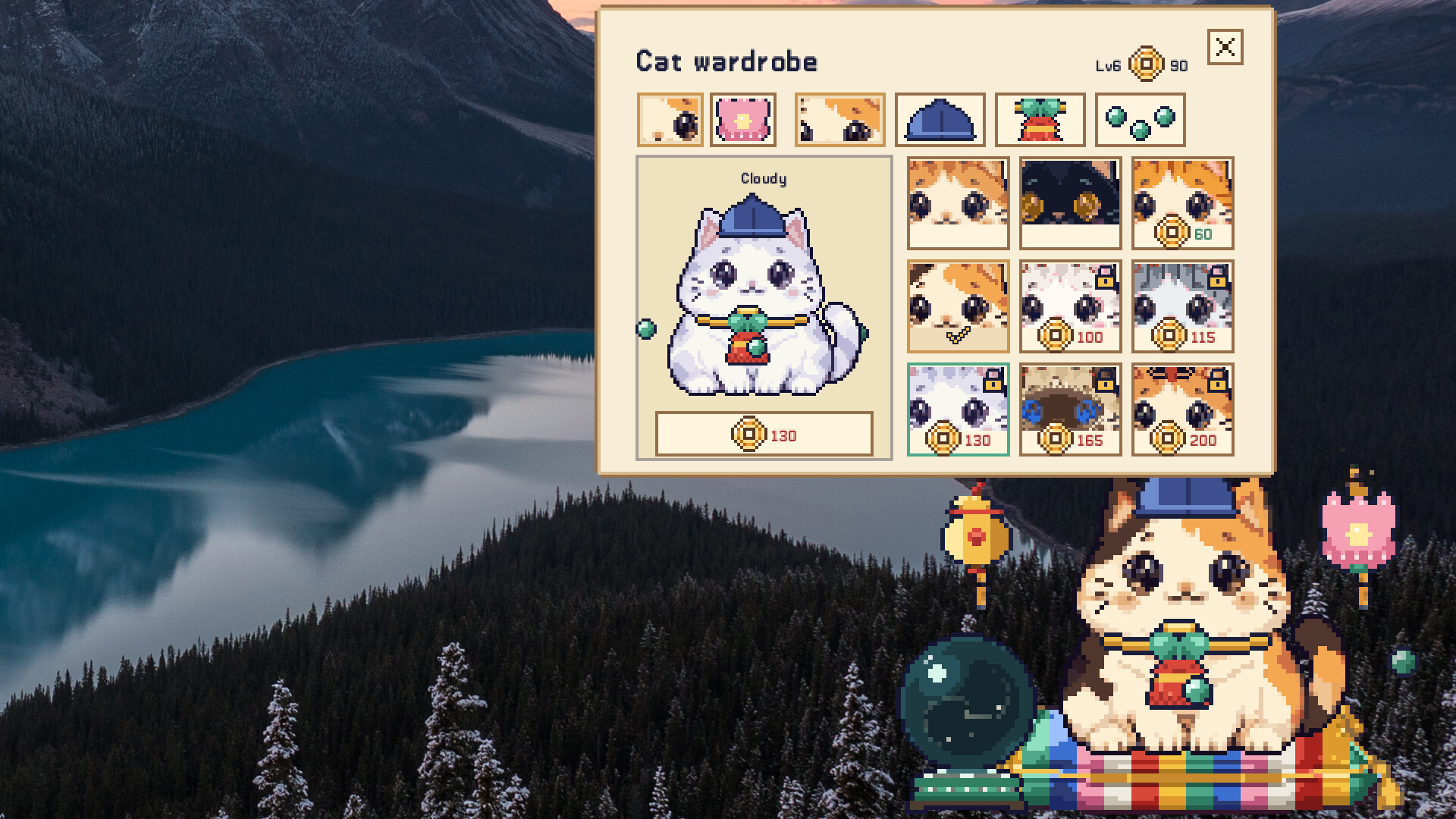
Boknyang’s wardrobe, with outfit prices in Bokjeon.
Generated Music and an Open Toolchain
For music, I generated tracks with ACE-Step 1.5, chose 16 for the game, and edited them; all 16 are AI-generated and MIT-licensed. The built-in player has play and pause, previous and next, a track list, a 0–100 volume slider and mute. When “Rainy Night” crackled, I replaced it with a clean version, moved its loop seam by 12 milliseconds, and raised output latency from 15 to 50 milliseconds.
I built the game in Godot 4 with GDScript. Claude from Anthropic helped as an AI coding assistant: the desktop history has 303 commits, and 253 of them carry a Claude co-author line. I would rather show those records than tell a neater story — a ported saju engine, clear currency limits, a generic timer name, reworked pixels and documented audio fixes.
— Lee Hee Sang, Noligo Games (HS Solution)
Saju Friend on Steam: https://store.steampowered.com/app/5383540/?utm_source=fixgaming&utm_medium=press&utm_campaign=fixstories
Desktop wallpaper in the screenshots: “Sunset over Peyto Lake”, Unsplash, CC0 via Wikimedia Commons.
For more stories from independent developers, read Fix Stories: I Put My First Game Away for Months — Then Released It.
Saju Friend
Release: November 5, 2026
Genre: Casual desktop companion / simulation
Developer / Publisher: Noligo Games / HS Solution
Platforms: Windows PC — Steam
Related Reading
2026: The Rise and Rise of Pixel Games
Fix Stories: Building Software From a 2006 Pathfinder
Story written by Lee Hee Sang of Noligo Games (HS Solution) for Fix Gaming Channel.
Edited for publication by Ronny Fiksdahl, Founder & Editor-in-Chief of Fix Gaming Channel.
Send interview pitches, corrections, tips, or developer stories to contact@fixgamingchannel.com.
Support independent games coverage on Ko-fi.