A Real-World Stress Test Signals a Seismic Shift in Online Game Architecture
A New Benchmark for Online Game Scalability
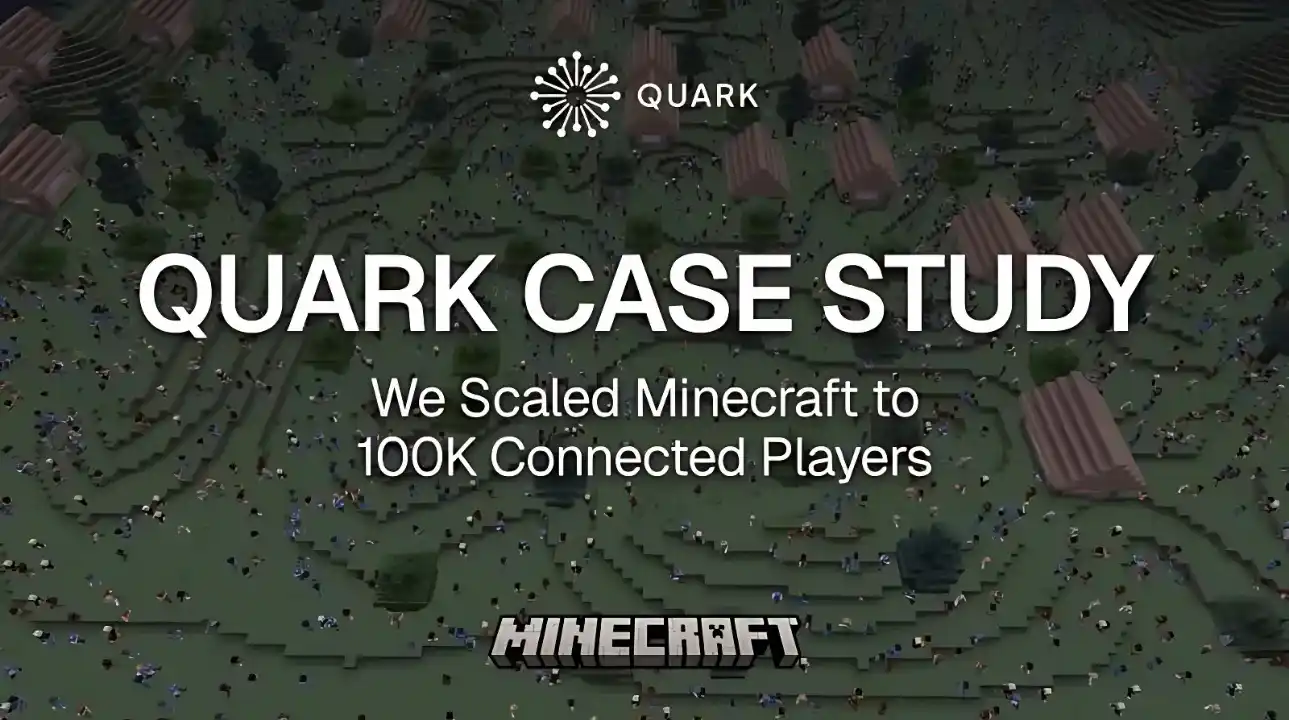
London-based deep tech company MetaGravity has just demonstrated what could become a new gold standard for real-time multiplayer infrastructure. In a controlled test, they achieved a working Minecraft server with 5,000 concurrent players—not spread across shards, but contained within a single, persistent world. This test was powered by their proprietary Quark engine.
It’s a glimpse into what may soon be both technically and commercially viable: online games capable of hosting 100,000 real players together, interacting in one unified space—without fragmentation, instancing, or artificial limitations.
Watch the technical demo on MetaGravity’s official page.
Join Our Newsletter
Stay updated with the latest interviews, previews, and indie gaming news from Fix Gaming Channel.
From Single-Core Bottlenecks to Causal Partitioning
Massively multiplayer games have historically been limited by what’s known as the strong scaling problem—where one CPU thread is responsible for too much real-time simulation, ultimately throttling player count and world complexity.
MetaGravity’s answer is Causal Partitioning—a distributed simulation architecture that processes player interactions based on cause and effect, not simple location. This design eliminates conventional bottlenecks by syncing only the events that truly matter between players.
“The creativity of the Minecraft community has always been limitless, but the technology had boundaries,” said Matthew Chuen, Head of Ecosystem at MetaGravity. “With Quark, we’re providing the scale and infrastructure to match that creativity, opening doors to new genres and player experiences.”
Why This Matters for Developers, Publishers, and Platforms
MetaGravity’s Minecraft showcase is more than a technical exercise—it’s a working proof of concept that directly challenges how the industry has approached large-scale game design for the past 20 years.
This shift unlocks the possibility for:
True mega-scale PvP: Not 100-player matches, but real-time 10,000-player warfare
Persistent, player-built civilizations: Cities, towns, and economies shared by thousands
Emergent systems: Governments, marketplaces, and storylines shaped by massive communities
New genres: MMO survival games, metaverse experiences, and procedurally governed digital societies
This level of scale, if proven stable, gives both indie developers and major studios the foundation to build systems once considered technically unachievable. For publishers and platforms, early adoption could mean being first to market with a next-generation online experience.
Hyperscale Minecraft Server Demo
Tech Showcase: June 17, 2025
Tested Game: Minecraft (Java Edition)
Engine: Quark Engine
Developer: MetaGravity
More Info: Official Quark Multiplayer on X
Written by Ronny Fiksdahl, Founder & Editor of Fix Gaming Channel.
Enjoy our content? Support Fix Gaming Channel with a donation via
Buy Me a Coffee.
Your support helps us keep independent gaming journalism alive. Thank you!