

How an AI Research Question Became a Game About Real Decisions
In this Fix Stories contribution, Matteo Angeloni, a PhD candidate and lifelong PC gamer, explains how he began creating NO AI ACT. What started as a coding experiment grew into an independent browser game built mostly on weekends, where players investigate the consequences of artificial intelligence decisions.
His account is part of our Fix Stories developer series. For another perspective on AI-assisted development, read how the creator of Futbolle used AI while building a game.
Play NO AI ACT in Your Browser
You can play NO AI ACT for free in your browser, with no account or installation required.
More Stories From the People Making Games
Get first-person developer stories, indie game coverage, interviews, previews and gaming news from Fix Gaming Channel.
Join Our Newsletter
Stay updated with the latest interviews, previews, and indie gaming news.
The first-person story below is by Matteo Angeloni and is reproduced in his own words.
From a Research Question to a Videogame: How NO AI ACT Was Born
A personal story about research, generative AI, weekends and the attempt to turn AI literacy into play.
I have always been a passionate videogame player.
I started as a child and, as I grew up, I remained a PC gamer. For years I had one of those ideas many players probably share: one day, I would love to create a videogame entirely of my own.
For a long time, though, it felt like a fantasy. I was not trained as a game developer, mathematics had never been my strongest subject and, although I have always considered myself creative, I could see a huge distance between imagining a game and actually building one.
I have also always believed that videogames can be something more than entertainment. I saw it in stories that stay with us for years, in the communities that grew with multiplayer games, and in the ability of a game to teach you something.
Sometimes a single concept is enough. A different way of looking at a problem. A moral choice. A piece of the world that you did not know before.
If I ever managed to build a game, I wanted some of that to be inside it. I wanted players to enjoy the experience and still leave with at least one thing they did not have before.
A small element of literacy.
The moment I decided to try
NO AI ACT was born almost by accident in Milan.
At the time, people were talking a lot about Claude Fable 5, particularly its programming capabilities. I asked myself a question:
“If it is really that powerful, can it make a small videogame?”
So I tried.
I did not yet have NO AI ACT in mind as it exists today. What I did have was a subject I was working on every day, artificial intelligence and decision making, and a recurring research question: how can complex issues surrounding AI be made understandable without turning them into another regulatory explanation?
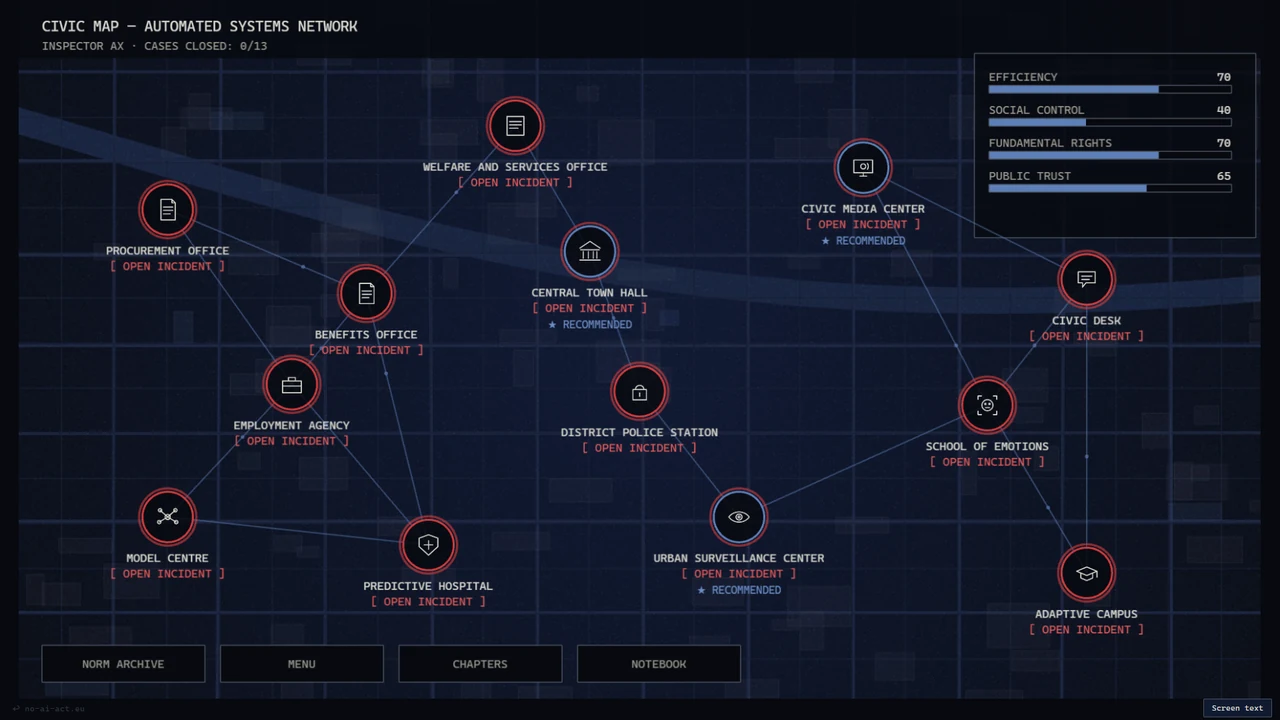
From that experiment, the idea of an alternative Europe in 2032 began to emerge, a timeline in which the AI Act had never entered into force.
What was supposed to be a test slowly became a real project. Generative AI lowered some of the technical barriers that had kept me away from game development. It helped me prototype, program and experiment.
But it could not decide for me which game was worth building.
A personal project, but not a solitary one
NO AI ACT did not grow only from the interaction between me and a machine.
My girlfriend, Dorine, has followed it since its earliest versions. Having someone willing to listen to half formed ideas, try incomplete builds, ask questions and encourage me to continue has mattered enormously.
The same is true of my PhD colleagues. The game developed through conversations, doubts and perspectives different from my own.
It remains a personal project, but it was not created in isolation.
Why a game
I am a PhD candidate researching artificial intelligence, decision making processes and their organisational and social implications.
The choice of a videogame was not only about passion. I was interested in one characteristic of the medium: at some point, the player has to choose.
A regulation can be read. A case study can be discussed. A videogame places you inside a situation and asks what you want to do.
I did not want to tell players what the correct answer was. I wanted to create situations credible enough to make them stop and think.
That is why NO AI ACT is set in a Europe where the AI Act does not exist. Its absence is not a political prediction and the game is not intended to be a perfect legal simulation. It is a narrative device. Removing that framework makes tensions more visible: innovation and protection, speed and caution, economic advantage and rights, efficiency and responsibility.
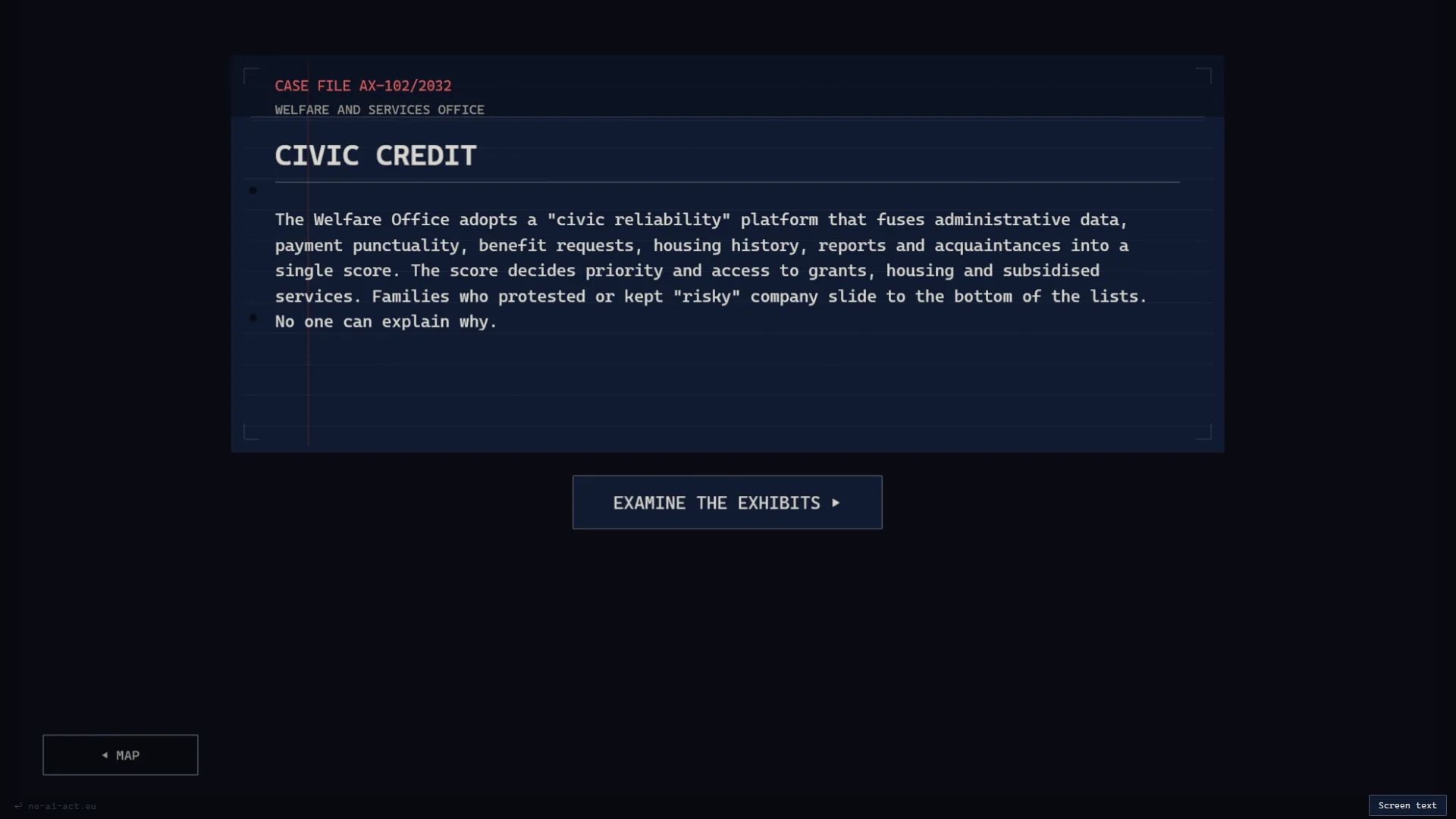
A case file introduces the AI system under investigation, the context in which it is used and the people affected by it. Image: Matteo Angeloni.
The hardest part has been turning complex concepts into playable decisions.
Risk, accountability, fundamental rights and responsibility work well in an academic paper. Inside a game, they can quickly become heavy. The danger was creating a training course disguised as a videogame.
I tried to do the opposite. The player receives incomplete information, encounters competing interests, gathers evidence and eventually has to make a decision. Only afterwards do some consequences become visible.
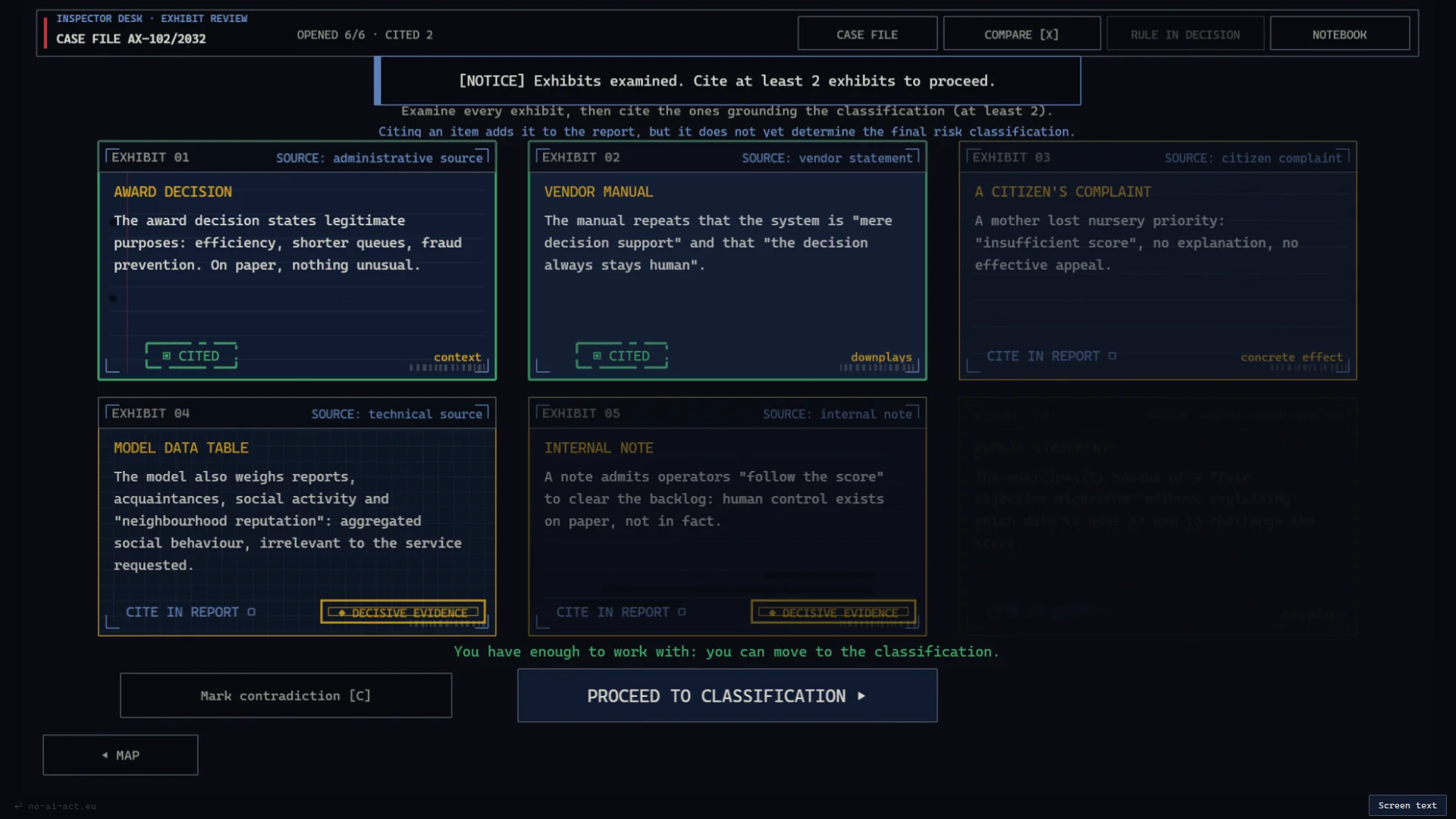
Players examine evidence from different sources and select the material that will support their final inspection report. Image: Matteo Angeloni.
The question that interests me is not, “Do you know the rule?”
It is, “Have you thought enough about the consequences of your choice?”
Learning through the effort of deciding
This is close to the way we often face real life. We rarely have all the information and all the possible consequences in front of us. We reason, make assumptions, take decisions and sometimes get things wrong.
If one option is obviously responsible and another obviously irresponsible, there is no real decision. The player simply recognises the answer they are expected to select.
I started working more on compromises. One decision may protect people more effectively but slow a process down. Another may produce an immediate advantage while introducing risks that become visible only later.
Some decisions are simply bad decisions. But I do want the player, at least sometimes, to genuinely think.
If NO AI ACT is going to provide any form of literacy, I believe it has to come from this. Not from memorising a definition, but from experiencing a problem.
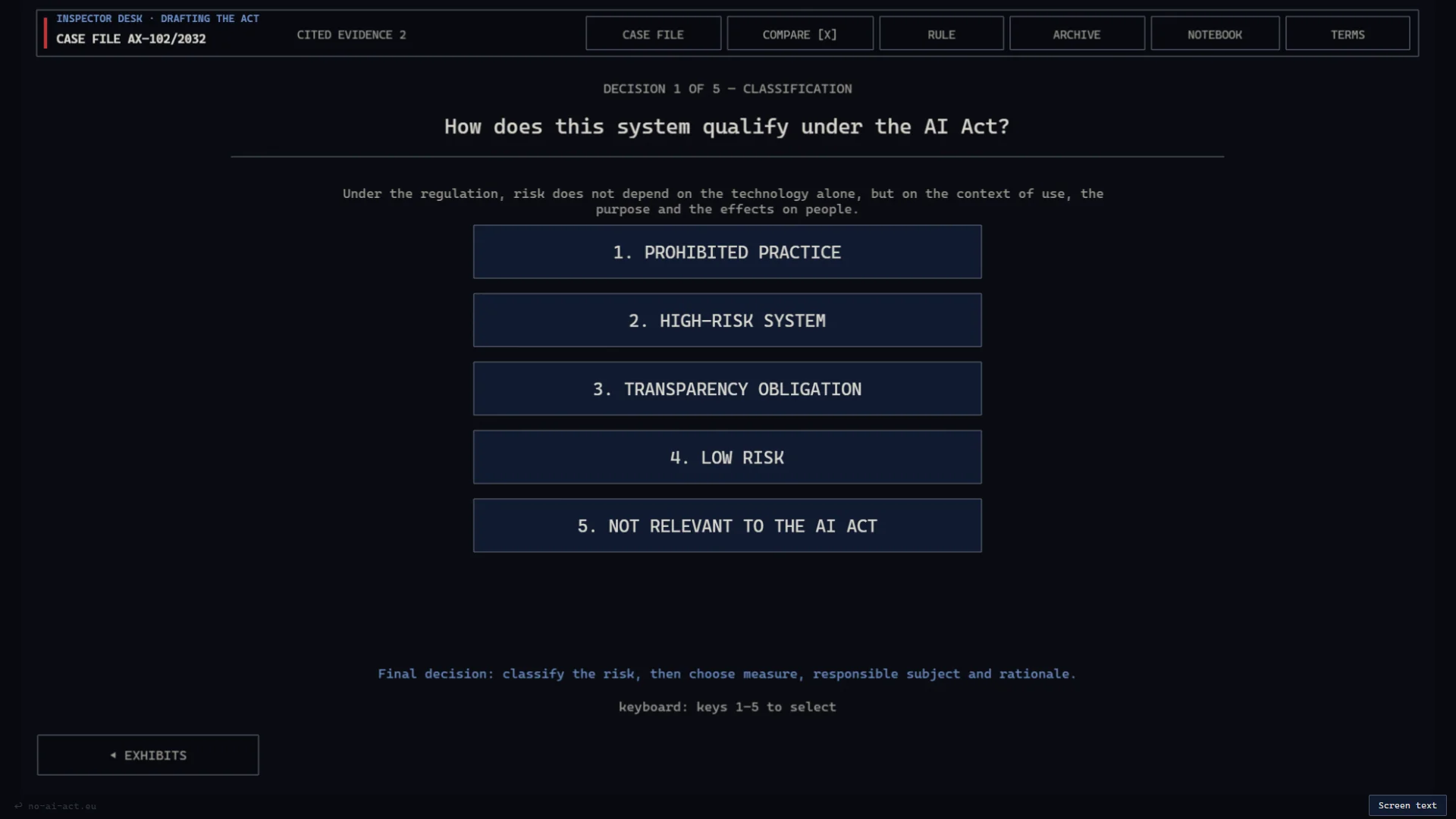
The player classifies the AI system under the AI Act risk framework before selecting the appropriate measure and accountable actor. Image: Matteo Angeloni.
Time, limits and weekends
NO AI ACT is not my full time job. I can work on it mainly during weekends, finding hours between my other commitments.
The list of things I would like to add often grows faster than the time available.
Sometimes that is frustrating. But I keep working on it because I enjoy it, because I believe in the idea and because every weekend I can make one small step forward.
There is no development team working eight hours a day on the game. There is mostly dedication, curiosity, passion and a certain amount of stubbornness.
That has made something else clear to me: a serious game still has to be a game. If the player is bored, the importance of the topic does not save the experience.
This is why I started looking for feedback outside academia. I wanted people to look at NO AI ACT first as a videogame. The first independent review from Absolute Gamer mattered to me for exactly that reason.
What I hope remains with the player
I do not consider NO AI ACT finished. I am still working on pacing and on how clearly consequences are communicated.
What I would like players to take away is simple. A question they were not asking before would already be enough.
When facing a new application of artificial intelligence, who is making the decision? Who will experience its consequences? Which interests are involved? Which risks are still invisible?
For me, the kind of literacy a videogame can offer begins here.
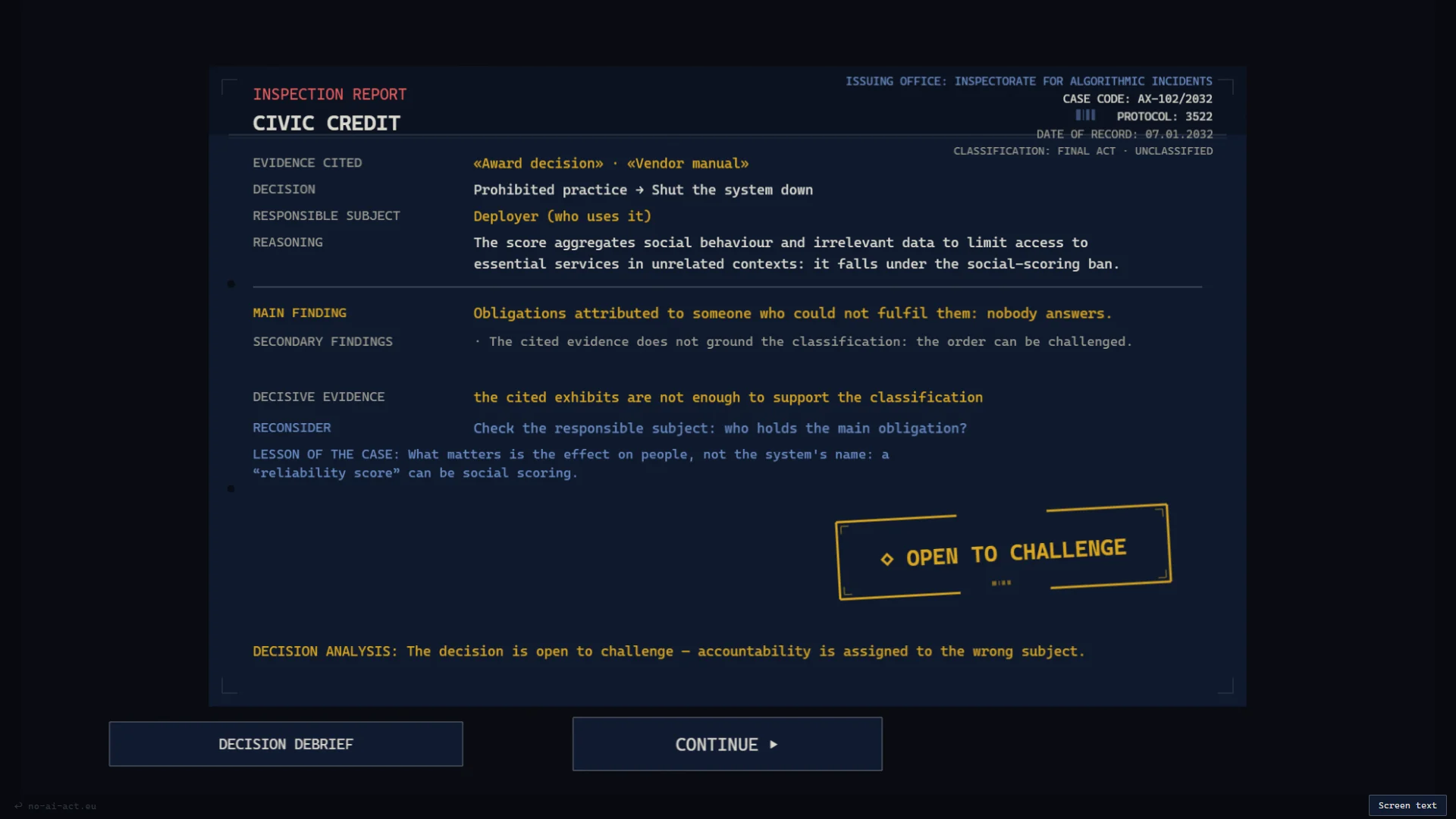
The final inspection report is evaluated on the risk category, the evidence and the reasoning used to justify the decision. Image: Matteo Angeloni.
Not by delivering an answer, but by placing someone in front of a problem and asking them to face it with the same things we use in real life: time, effort and reasoning.
That is exactly what NO AI ACT is trying to do: turn a research question into a decision that someone, on the other side of the screen, genuinely has to make.
Fix Gaming Channel: This developer-authored Fix Stories essay was provided by Matteo Angeloni and formatted for publication without rewriting his account. The game is an independent project, not an official output of the University of Tuscia.
The official NO AI ACT website currently describes 14 playable investigations and says educational outcomes have not yet been empirically validated. Matteo has openly disclosed using generative AI for prototyping, coding assistance, debugging and experimentation.
Another developer’s experience with AI-assisted game creation appears in our Hoop Dynasty Fix Stories contribution.
NO AI ACT
Release: Available to play in browser; ongoing development
Genre: Investigative serious game, AI-literacy simulation
Developer: Matteo Angeloni
Platform: Web browser — Play free
Related Reading
Fix Stories: The Parts of Futbolle an AI Could Build, and the Parts It Couldn’t
Fix Stories: The Game Existed Before the Interface — How AI Helped Me Bring Hoop Dynasty to Life
More Fix Stories From Game Developers and Creators
Story written by Matteo Angeloni, PhD candidate and creator of NO AI ACT.
Edited and published by Ronny Fiksdahl, Founder & Editor-in-Chief of Fix Gaming Channel.
Send developer stories, creator stories, corrections, tips, or game pitches to contact@fixgamingchannel.com.
Support independent games coverage on Ko-fi.