A basketball career RPG that began in 2014, with AI-assisted workflows now helping bring its systems to life.
Fix Stories is a dev-authored series. This story is written by Giulio, solo developer and creative director of Hoop Dynasty: Rise of a Legend.
Read more first-person developer stories in Fix Stories.
Hoop Dynasty: Rise of a Legend Gameplay Trailer
Want more stories from the people making games?
Get more developer stories, interviews, reviews, indie coverage, and gaming news from Fix Gaming Channel.
Join Our Newsletter
Stay updated with the latest interviews, previews, and indie gaming news.
A basketball career is easy to summarize and difficult to simulate. A box score can tell you what happened in a game. It cannot tell you what that performance changed: whether a coach trusts you more, whether a teammate sees you differently, whether a contract becomes possible, or whether one bad decision follows you into the next season.
That missing continuity is why I started building Hoop Dynasty: Rise of a Legend in 2014. I did not want to make a game about controlling every dribble, and I did not want the player to disappear behind a spreadsheet. I wanted to build a basketball career RPG for Windows PC where you live one player’s journey inside a world that keeps moving around you.
The idea was simple to describe: begin as a prospect, earn a role, navigate relationships and pressure, play through the consequences of your decisions, and try to become a legend. Building the systems that could remember that journey was much harder.
For years, the game was real but difficult to see
Long before the current generation of AI tools, Hoop Dynasty already had its foundations: a database, simulation engines, competition structures, career logic, progression, contracts, team systems and a persistent basketball world. Those systems were not a concept produced by an AI agent. They were the game I had been designing and building for years.
But there is a painful truth in game development: a system can be deep, coherent and technically alive while remaining almost invisible to the player.
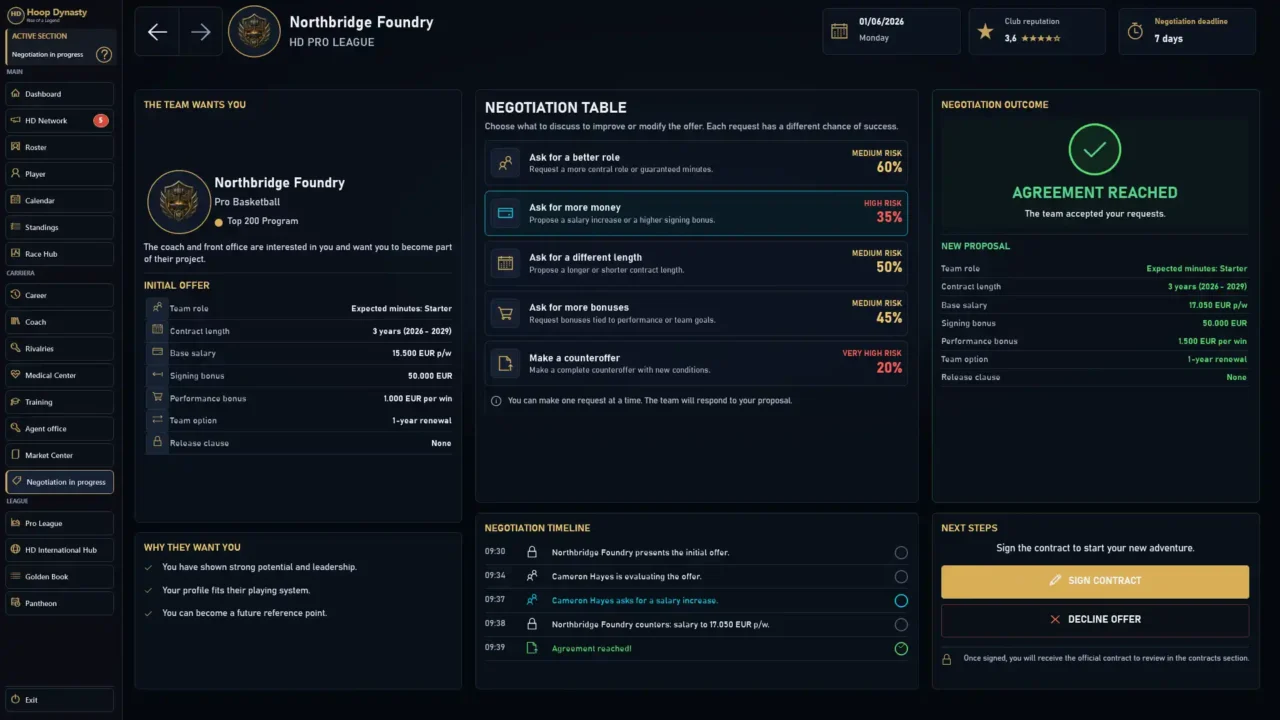
If the interface cannot explain why a role changed, the system feels arbitrary. If a post-game screen shows numbers without consequences, the career feels disconnected. If a contract negotiation does not reflect the player you have become, the world feels like a collection of menus rather than one continuous story.
For a solo developer, that translation from simulation to experience can become the largest part of the work. It is not enough to calculate the world correctly. You have to decide what the player needs to see, when they need to see it, and what can stay beneath the surface.
That was my bottleneck. The game existed in its engines. I needed to make it legible, visual and emotionally coherent.
The interface is where the simulation makes a promise
Hoop Dynasty is built around one player-facing career. Preparation leads into the Locker Room, decisions shape the context, the Match Center makes the game readable, and the post-game flow carries performance into development, reputation and the next opportunity.
The important word is not “screen.” It is “flow.”
A match should not be an isolated calculation. A strong performance should affect more than one number. A difficult answer to a coach or reporter should not exist only as dialogue. A contract should not be a detached minigame. All of those moments must describe the same player and the same history.
That principle guides the RPG side of the game as much as the management side. The choices are personal because the consequences are systemic. You are not an invisible executive moving pieces from above. You are the person whose minutes, role, relationships, health, reputation and future are being changed.
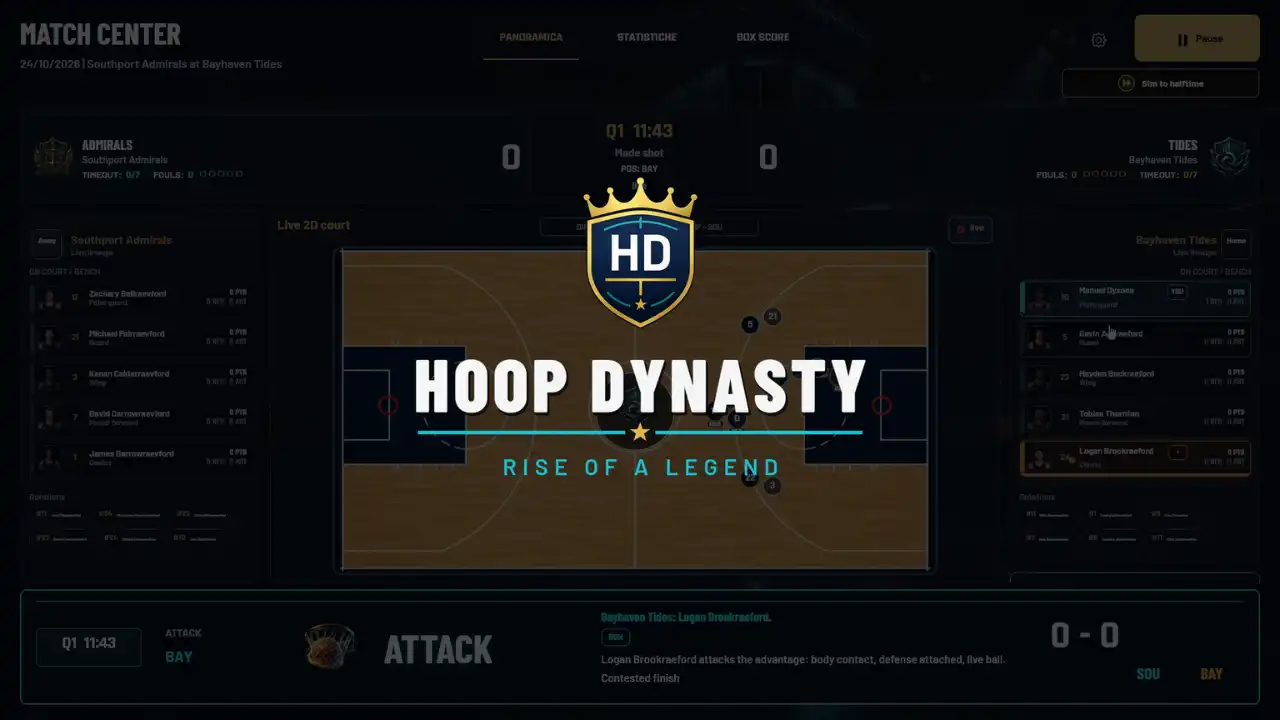
The Match Center turns the underlying basketball simulation into a player-facing game flow, connecting live action, lineups and match context.
AI changed the speed, not the ownership
The recent acceleration of Hoop Dynasty came when I began using AI-assisted workflows in the areas where a solo project was moving too slowly: UX iteration, selected visual assets and QA.
That distinction matters to me.
AI did not invent the game. It did not create the original database or simulation engines. It does not decide the rules of the world, establish the creative direction or approve its own output. I remain responsible for the architecture, game design, visual direction, selection and final result.
What AI changed was the number of ideas I could examine before committing to one.
For UX, that means exploring how a complex system might be presented, comparing alternatives and then refining the version that serves the player best. For selected visual assets, it means giving form to a fictional basketball universe under a consistent art direction, then rejecting anything that does not belong. For QA, it means using assisted analysis to stress systems, search for edge cases and expose contradictions that deserve human investigation.
The value is not that the first answer arrives faster. The value is that I can reach the tenth serious iteration while I still have enough time and energy to judge it properly.
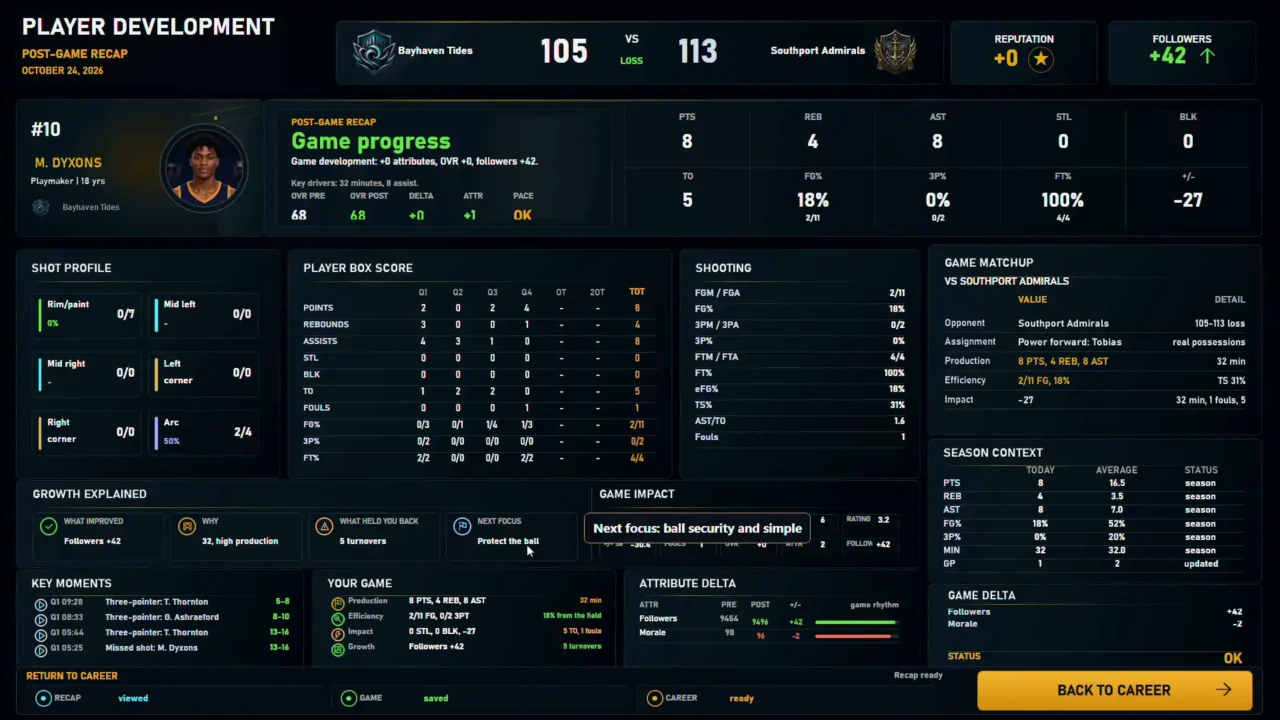
Post-game development connects the box score to progression, reputation and the next career decision instead of ending at the final buzzer.
Faster work creates a higher standard
Speed is useful, but it also creates a new risk: producing more than you can meaningfully evaluate.
An AI-assisted image can be technically impressive and still feel wrong for the world. A proposed interface can be clear in isolation and still break the career flow. A QA finding can sound convincing and still misunderstand the system it is testing. More output does not remove the need for taste, context or responsibility. It increases it.
I therefore treat assisted output as material to evaluate, not truth to accept. Ideas remain candidates until they survive review. Visuals can be rejected. UX can be rebuilt. A test result is not accepted until the evidence behind it makes sense. The final decision is human because the consequences of that decision belong to the game and to its players.
This has become one of the most important lessons of the project: AI can reduce the cost of iteration, but it cannot tell me what Hoop Dynasty should remember.
That question remains mine.
The world has to remember the player
The goal is not to build the largest possible collection of systems. It is to make every system reinforce the same career.
The Match Center, player development, team relationships, contracts, national-team opportunities, economy and long-term history should not produce competing versions of the truth. They should agree on what happened and carry it forward.
That is also why the project has taken so long. A career game makes a promise measured in seasons, not minutes. Rosters change. Competitions advance. Opportunities open and close. The world must survive success, failure and time without forgetting how it arrived there.
The visual side is finally allowing that depth to become visible. A player can see not only a result, but the chain that connects preparation, performance and consequence.
The interface is no longer decoration placed over the engine. It is the part that explains the engine’s meaning.
What I would tell another solo developer
Do not confuse acceleration with authorship.
Use tools that help you test more ideas, expose more weaknesses and move through repetitive work faster. Be transparent about how you use them. But decide what your project is before asking a tool to help you express it, and keep the authority to reject everything that does not serve that direction.
For me, the most useful question is never “Was AI involved?” The useful questions are: Who designed the system? Who chose the outcome? Who checked the work? Who is responsible when it fails? In Hoop Dynasty, that responsibility is mine.
I am now preparing the first closed Steam Playtest, where the project will face the kind of feedback no internal workflow can replace: real players building real careers and finding the moments that still do not communicate what the simulation knows.
AI did not give Hoop Dynasty: Rise of a Legend its direction. It helped me iterate fast enough to make that direction visible.
The game existed before the interface. My job now is to make sure players can finally feel both.
Fix Gaming Channel: Fix Stories gives developers and creators room to tell the stories behind their work in their own words. This story was submitted by Giulio and formatted for publication by Fix Gaming Channel.
Hoop Dynasty: Rise of a Legend
Release: In active development; Steam page public; first closed Playtest in preparation
Genre: Basketball career RPG, sports management and simulation
Developer: Giulio — solo developer and creative director
Platform: Windows PC — Steam
Website: Hoop Dynasty
Trailer: Official Gameplay Trailer
Related Reading
Fix Stories — Real Stories From Game Developers and Creators
Fix Stories: I Always Wanted to Run a Band, So I Built One
Fix Stories: Where Spears & Spirits Came From
Story written by Giulio, solo developer and creative director of Hoop Dynasty: Rise of a Legend.
Edited and published by Ronny Fiksdahl, Founder & Editor-in-Chief of Fix Gaming Channel.
Send interview pitches, corrections, tips, or developer stories to contact@fixgamingchannel.com.
Support independent games coverage on Ko-fi.