



Why One Developer Chose a Grand Strategy Scope He Could Actually Finish
For this Fix Stories feature, solo developer Colin Teberg shares why he started building Iron Dice, a medieval grand strategy game designed around readable systems, meaningful decisions, and campaigns players can realistically finish.
Six years of solo development built around one simple problem: finishing the campaign
Colin has been working on Iron Dice since August 2020. With the game heading toward its November 2026 release and a public demo already available, this is his story in his own words.
Read more first-person developer and creator stories in Fix Stories.
Want more stories directly from game developers?
Get more developer stories, interviews, reviews, indie coverage, and gaming news from Fix Gaming Channel.
Join Our Newsletter
Stay updated with the latest interviews, previews, creator stories, and indie gaming news.
I love grand strategy games, but I almost never finish a campaign. I like choosing a country, looking at the neighbors, and deciding which piece of the map I want first. I like building an economy that can support a war, and finding out that the war I thought would be easy was a terrible idea. Somewhere along the way, though, I usually stop playing. I wanted to make a game that kept those decisions and got me through a whole campaign.
That’s where Iron Dice came from. I’ve been working on it solo since August 2020. Six years is a long time to spend making a game about finishing things, but here we are. It’s a medieval grand strategy game that runs in real time with pause, set in the kingdoms left behind after an empire falls apart. You build, trade, research, negotiate, and fight. The campaign covers 100 years, with a playing time designed to be around two to five hours. I still want room for a bad war, a recovery, and another attempt.
The length is only part of it. I also want to understand what I’m doing. If I spend money improving a province, I want to know what I bought. If my income drops, I want to be able to find out why. If I lose a battle, I want enough information to make a better decision next time. There is plenty of room for difficulty in that. Knowing how something works doesn’t mean you’ve figured out how to win.
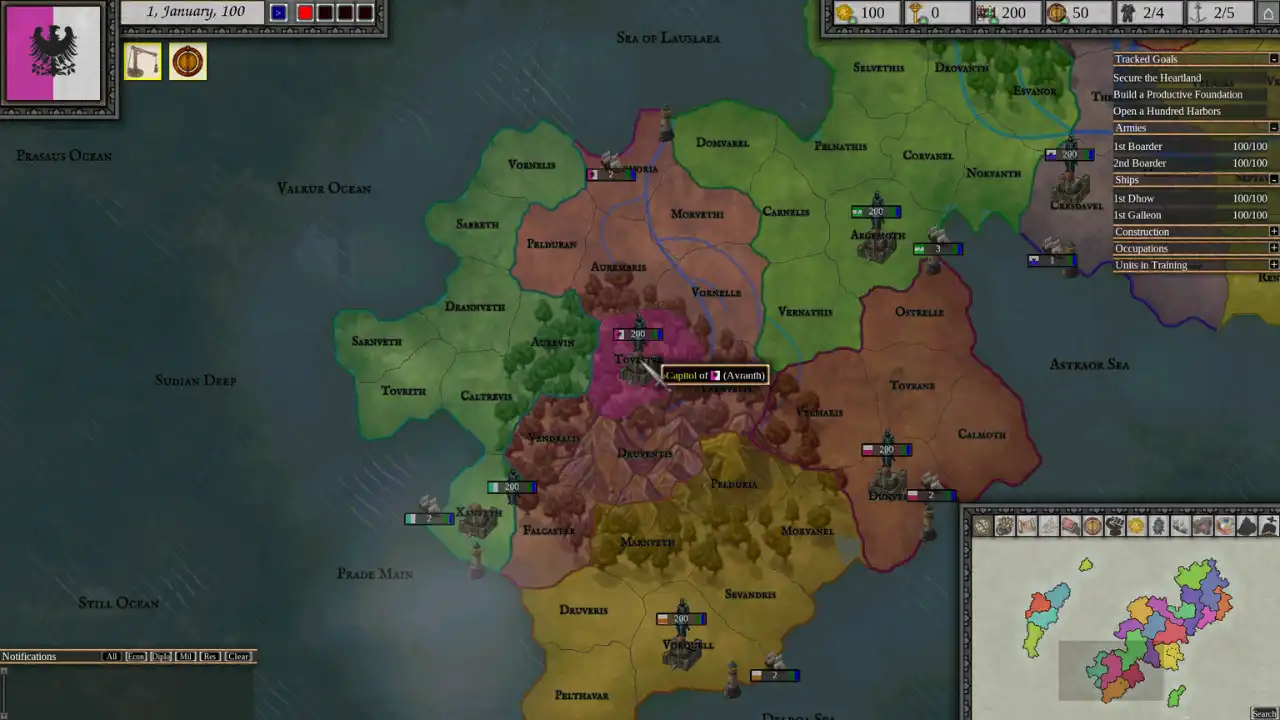
A province is a good example. Taking it changes the border, which is satisfying on its own. But it also changes what your kingdom produces and earns. It may extend a trade chain. It gives you new neighbors and more ground to defend. I want the player to look at that province and have a reason to take it beyond wanting a bigger name on the map. Although wanting a bigger name on the map is a perfectly reasonable motivation too.

Trade connections across the map. A province can matter for its place in a trade chain.
That means spending time on fairly small things. An income number needs a breakdown. A building needs to tell you about its upkeep before you commit to it. A button you can’t use needs to explain what you’re missing. Those details don’t make much of a screenshot by themselves, but they matter when you’re trying to decide whether you can afford another army. The calculation can be complicated. Getting an answer to that question shouldn’t be.
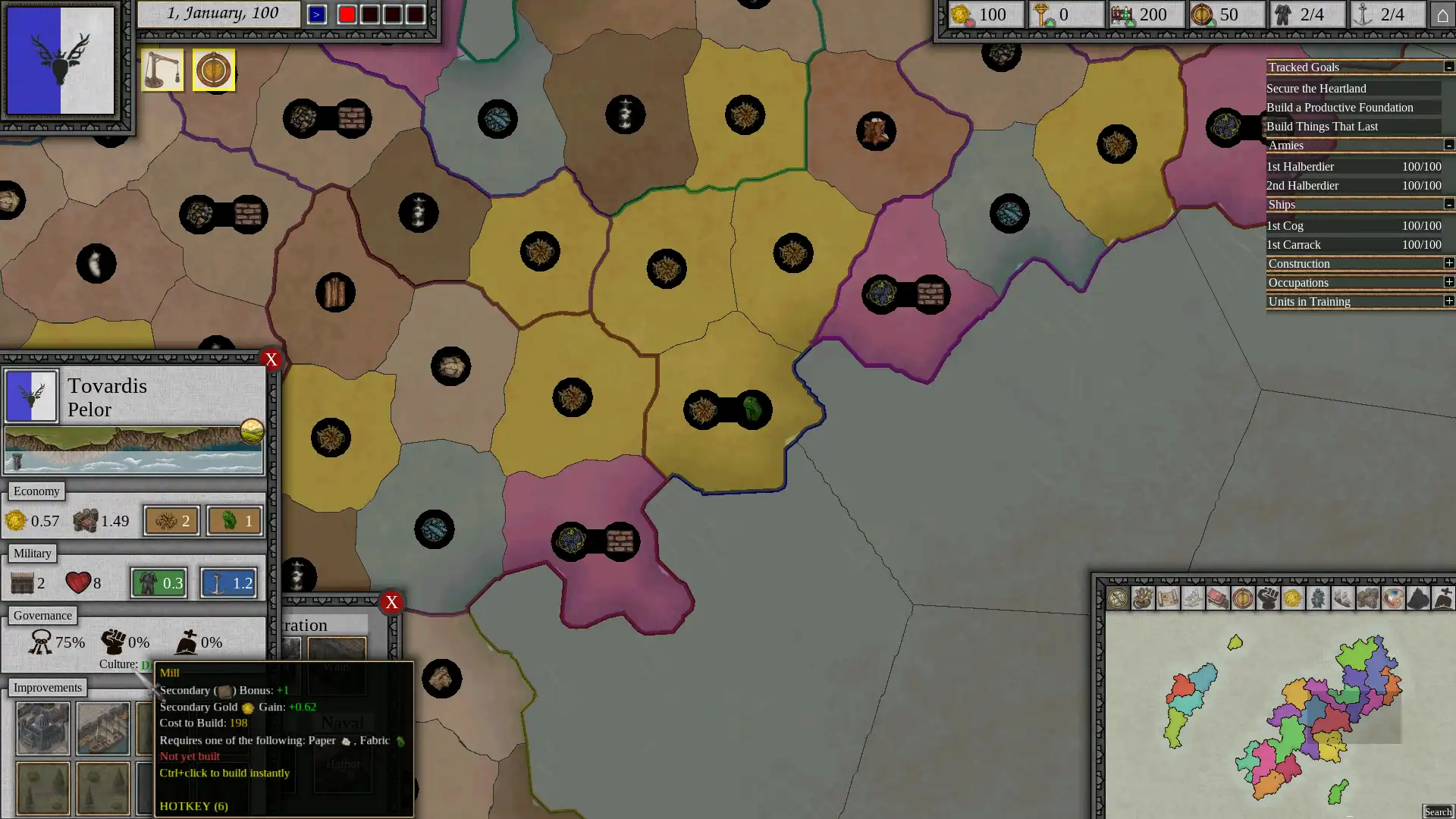
The province economy view, with production, improvements, and a breakdown of income.
War has the same problem. Before moving an army, you can inspect its destination, arrival time, enemy strength, and estimated outcome. An estimate gives you something to base a decision on. You still have to decide whether the fight is worth taking, whether you can replace the losses, and what happens elsewhere while your army is busy. I like those questions. They’re the reason to have an economy and diplomacy in the same game as the fighting.
Working alone puts all of this back on me. I write the rules, then I have to explain them in the interface and teach them in the tutorial. In the tutorial, even building walls means covering their cost, upkeep, construction time, and what they do when an enemy arrives. It’s easy to treat that as one obvious action when you already know the game. For someone opening it for the first time, there’s a lot in that one click.
The public demo has been useful in making that distinction less theoretical. Some early players said the game was too hard and the world lacked flavor. That’s a fairly direct response to a game I’m trying to make approachable. It also gives me two different problems to work on. Players need to understand the decisions, but they also need reasons to care about the kingdom they’re making them for. Having the systems in place doesn’t settle either question.
One concrete change was the scope of the demo. It had a ten-year limit. I changed it to include the full 100-year campaign on Anvil, alongside the tutorial. Anvil has 19 playable kingdoms and 201 provinces. The full game has more maps, but the demo lets you finish the campaign you started. For a game built around wanting to finish a campaign, cutting the demo off early was a strange way to introduce it.
I’m now preparing for October Steam Next Fest. The demo is already public, so there’s a playable game for people to judge while I keep working on it. The questions I care about are fairly practical: where did you get stuck, what was confusing, was the difficulty interesting, and did you want to keep going? A working feature isn’t much use if nobody can make sense of it, and a clear interface isn’t enough if the decisions underneath it are dull.
I don’t expect Iron Dice to replace the enormous strategy games I enjoy. I wanted another option: pick a kingdom, make some plans, get a few of them wrong, and reach the end. That’s the game I’m trying to finish making.
Iron Dice
Release: November 2026
Genre: Grand Strategy, Strategy
Developer / Publisher: Steady State Scientific Computing / Steady State Scientific Computing
Platforms: Windows, macOS, Linux via Steam
Fix Gaming Channel: Fix Stories gives developers and creators room to tell the stories behind their work directly in their own words. Colin Teberg’s submitted story above has been preserved in his voice and formatted for publication by Fix Gaming Channel.
Related Reading
Fix Stories: Hound Riders and the Fight to Stay Original
Fix Stories: The Game Existed Before the Interface
More Fix Stories from developers and creators
Story written by Colin Teberg, solo developer of Iron Dice.
Edited and published by Ronny Fiksdahl, Founder & Editor-in-Chief of Fix Gaming Channel.
Send developer stories, creator stories, corrections, tips, or game pitches to contact@fixgamingchannel.com.
Support independent games coverage on Ko-fi.