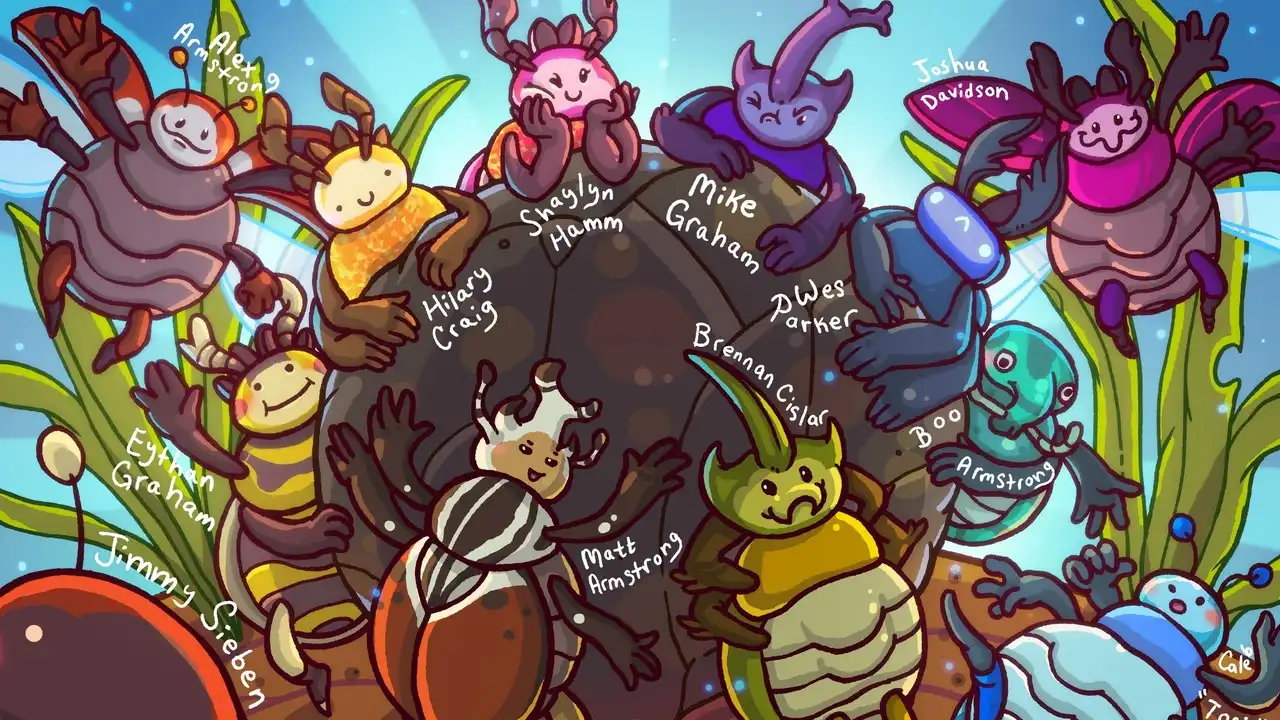
From Borderlands to Dung Ho!: Matthew Armstrong and Lesser Weevil on Co-op Chaos, AAA Risk, and Building Something New
Matthew Armstrong, Mike Graham, Shaylyn Hamm, and Hilary Craig discuss the origins of Dung Ho!, the lessons behind cooperative design, and why smaller studios may be better positioned to take creative risks.
Matthew Armstrong has worked on games including Half-Life: Decay and the original Borderlands. He is now part of Lesser Weevil, the team behind Dung Ho!, a cooperative physics-based game built around moving and protecting one shared dung ball.
In this Fix Gaming Channel interview, Armstrong and members of the wider team discuss cooperative design, unpredictable player behavior, the difficulties of securing support for original AAA concepts, and the balance between professional experience and allowing a strange game to remain genuinely silly.
Matthew Armstrong on Co-op, Borderlands, and Creative Risk

Matthew Armstrong of Lesser Weevil. Photo supplied by Lesser Weevil.
One of your early credits was work on Half-Life: Decay for PlayStation 2, a rare cooperative experiment within the series. What did designing specifically for two players teach you about cooperation and making players depend on each other, and do any of those lessons still influence Dung Ho! today?
MATTHEW ARMSTRONG: Co-op is social in a way that is far beyond competitive play. It’s more about the relationship of the players than the game itself. Because of this, you have to watch the players play. Back in the PS2 days, you didn’t get patches. Post launch, seeing people play the game, there were lots of things we would like to adapt and evolve, but once shipped, you were done. Also, this was the very early days of co-op, so there wasn’t a good death mechanic in there. Dying in co-op often means sitting around watching your friends play with nothing to do.
With Dung Ho, we removed all death from the players so you’re never out of the game. All health is in the ball, so it’s a communal health pool and a shared purpose.
We are also actively evolving the game after watching people play. We’re growing the game with the community, and the more the community grows, the more we’ll be able to grow the game to be great for them.
When you first developed the idea for Borderlands, what convinced you that combining a first-person shooter with role-playing progression and procedurally generated weapons could become more than an interesting experiment?
MATTHEW ARMSTRONG: It was really a simple case of there was a game I wanted to play that didn’t exist, and I was given a chance to make it. I never doubted the treasure hunting for guns loop at all. It was pretty tricky convincing everyone else, though.
There weren’t a lot of co-op games at the time, and they expected you to act like a professional fire team. But that’s not how most people play. Most people in co-op games act a bit silly, so we wanted a game that was a bit more loose and chaotic and forgiving. I think players can feel a lot of that same energy in Dung Ho.
Dung Ho! Trailer
The original Borderlands combined genres and ideas in a way that was unusual for a major release at the time. If that exact concept were being pitched for the first time today, do you think it would still be approved and funded as a AAA game, or has the industry become too focused on established formulas and lower-risk projects?
MATTHEW ARMSTRONG: Yeah… I’ve tried. It’s disappointing to make something strong that’s going to change the landscape, and then half way through development the money people second guess themselves and get cold feet. Then a year later, another game comes from some small indie studio that does the same thing you were doing and is a huge hit. The industry is full of stories of big games getting cancelled half way through development. I promise you some of those were your new favorite game – and the publisher’s new tentpole IP – and you’ll never get to play them.
After spending years on major productions, you have moved toward smaller and more focused projects with Lesser Weevil. What can you create with a small team that would be difficult or impossible inside a large AAA studio?
MATTHEW ARMSTRONG: Can I just take a moment to compliment you on the flow of these questions? Each answer dovetails to the next question. Very well done.
And from that compliment, you can guess my answer. Getting a publisher to work on an exciting new idea isn’t impossible. Getting them to ship it is the challenge. With smaller games, we can have an idea, make it fun, and ship it fast. We aren’t making games for a publisher. We’re making games for you. If Dung Ho does well enough, we will be able to stay fully independent and can make some very cool games going forward.
Building Dung Ho! With the Lesser Weevil Team

Mike Graham of Lesser Weevil. Photo supplied by Lesser Weevil.
The earliest prototype has already been described as a simple ball in a grey Unreal test environment. Once the team knew that basic interaction was funny, what transformed it from an amusing prototype into a game that could sustain a complete multiplayer experience?
MATTHEW ARMSTRONG: Giving players multiple things to do! There’s scouting. There’s catching the ball. There’s pirates to fight. A player should always have something to do and a way to help the others.
MIKE GRAHAM: Well, I can’t say the basic interaction at that point was necessarily fun or funny. It was, however, simple and clear – which I think makes for a great core objective. Everyone understands the concept of ROLL BALL. The challenge at that point was finding relatable context or real world analogy for it. Our next prototype was a small level with a few oversized props – and an egg shaped “ball”. We immediately realized that it was more fun to push something that was a bit unreliable. The egg shape created a certain amount of unpredictability and chaos that was fun – and the concept of escorting an egg as small birds felt relatable, but we all felt it was too mundane of a concept. Then someone suggested dung beetles… which led to hours and hours of watching hilarious documentary videos on the lives of dung beetles. If you’ve never seen one, watch one. They are nature’s most slapstick creature. Every single stick and rock is like the world’s biggest obstacle for them. Our group chat quickly became full of silly clips and images of dung beetles trying to overcome the most basic things – and THAT felt like a compelling premise to build from.
Physics-based comedy often depends on players feeling slightly out of control, but too little control can quickly become frustrating. How did the team establish the boundary between entertaining chaos and mechanics that simply felt unreliable?
MATTHEW ARMSTRONG: This is a challenge. Part of it is defining what the “enemy” is. Is it the ball physics, or the world, or the controls? We actually have shifted this a bit now that there are pirates. With Pirates taking more of the “enemy” role, we made the ball a little bit faster and easier to control. You should always feel like you are mostly in control, but also always feel like you can lose control in a moment with a poor decision or unexpected bump.
MIKE GRAHAM: Trying to strike a balance between reliability and chaos is hard. From a level design perspective, we operated under a few core principles: 1. The path is your friend, 2. Nothing is flat for too long, and 3. you can usually fail forward.
Our early prototypes had some patches of “safe” terrain mixed with large sections of “rough”. But it never felt like you had any real agency, and the moment to moment gameplay felt lacking. So we added safe paths that were just wide enough to allow players to feel skillful while also guiding them towards useful items and objectives. By creating slight slopes and undulations throughout the map, it forced players to constantly reposition themselves – making it even harder to stay on the path and keep the ball safe. Now, if the ball got just a little bit away from you and it went off course, you felt it without it having to result in catastrophic failure. And when you do fail, and the ball topples into a water hazard, we try to give players a way forward. At that point, you’ve already paid the price of losing dung health – so backtracking seemed unnecessarily harsh. But it was also critical to put players in tough situations so that they are incentivized and rewarded (or punished) for using items.
Rolling one shared object creates a very different form of cooperation from games where every player pursues an individual objective. How did that central idea shape the game’s levels, obstacles, and approach to teamwork?
MATTHEW ARMSTRONG: It’s absolutely core. A dung ball is the most important thing in the world to a dung beetle. People might think it’s gross, but it’s absolute treasure to them – like a big ball of cash and candy for us. We wanted to make it feel like a character. It also solves a core problem with lots of co-op games. Ever play a game and then realize you don’t know where anyone else is? You’re suddenly playing alone in a game that’s supposed to be co-op. Well, that never happens here. Everyone is protecting one central heart and has one unified focus.
MIKE GRAHAM: The basic idea for cooperative play was to have roles for each player. Not defined roles – but enough tasks to keep players juggling. While everyone can technically push the ball together, it’s not optimal. In fact, most of the time you will end up bumping your friend and cause unintended chaos. So you can push the ball, but you can also be a spotter, you can scout and retrieve items, and there are even totems you can find that give you buffs to various abilities, so new roles emerge from finding those. But the exciting new role is crowd control! Now that we have added pesky pirates, protecting the ball from attacks has become very important – and provides a new risk/reward element that our early release never had.
What did playtesting reveal about player behavior that the team had not anticipated, particularly when people began interfering with one another, improvising solutions, or deliberately creating chaos?
MATTHEW ARMSTRONG: This is not a game about PUSHING a ball. It’s about MOVING a ball. It’s a co-op physics based problem solver.
But some players don’t engage on that level. They charge straight forward, punch the ball, smash through water, and destroy it fast. Now they have a half dead ball, they have no items, and they’ve only gone a short distance. Other players leave the ball at the start, look around and grab a couple of items, then build a physics contraption and LAUNCH the ball half way across the map. Now they are a mile in front of the impatient people with a healthy ball facing new traversal challenges.
The charging players see this… and next game they immediately bash the ball across the water.
Okay. It’s a much harder game that way, but it’s your game! Play how you want. We put a couple extra dung piles of health near the start for those guys.
I do suggest keeping out of the water, though. It’s a killer.
MIKE GRAHAM: One of the greatest things to witness and experience is how players will almost always create more chaos than anything we do in the level. The greatest obstacles in the game are the ideas that your teammates have.

Shaylyn Hamm of Lesser Weevil. Photo supplied by Lesser Weevil.
The beetles need to be expressive and visually distinct while several players and environmental hazards may be moving at once. How did the art team balance character personality with immediate readability during hectic multiplayer sessions?
SHAYLYN HAMM:
Things like beetle colors, items, and enemies have to stand out from their surroundings, so for these important things I usually prefer using colors that are more saturated, contrasting in value, or complimentary to the environment.
For an example in the new Pirates update, you can see the color purple used repeatedly with pirate-related things. The paracroprids(pirates), pirate ships, and forts all contain at least some of this color, not just to tie them together thematically, but because purple is complimentary to the greens and neutral shades that you see much more of around you!
Several members of Lesser Weevil have worked on recognizable AAA productions. How does that experience help a small studio, and can it also create expectations that do not fit the stranger, more playful game the team wanted to make?
MATTHEW ARMSTRONG:
The Good: This is a highly experienced team. Many of us have worked together before. We’ve also been through the wringer, so not a lot of drama. The game is polished and you can feel that nice “pro sheen” on it.
The Bad: Our expectations are maybe too high? Games are succeeding in this space that were built slap dash in a couple of months, and we’ve built a huge polished pretty world with lots of depth and original music and art and over 90 unique cosmetics. We can easily fall into a trap of overthinking and overdesigning. It’s important to let the game be silly and let chaos reign when things go bad.

Hilary Craig of Lesser Weevil. Photo supplied by Lesser Weevil.
Hilary, how do you communicate a game as unusual as Dung Ho! without overexplaining its humor or allowing the central joke to overshadow the depth of the cooperative experience?
HILARY CRAIG: I think one of the most important things in communicating this genre is ensuring that everyone is invited into the joke and the fun. You can’t be exclusive with it, and you also can’t be the funniest one in the room as a brand – that’s meant to be a role for the player. You want to leave some space for people to make their own fun and humour in the gameplay. That being said, ensuring there’s the seeds of a joke or humour in your messaging is important of course because your brand needs to represent the fun of the game in the market. It’s a healthy balance that you need to strike. When dealing with subject matter like ours (dung and poo), you also can’t be too gross about it. I do have to admit it’s the first time in my career I’ve had to be very specific about my approach to that kind of humour. Usually you just avoid it altogether!
Is Dung Ho! representative of the focused cooperative games Lesser Weevil intends to continue making, or is the studio deliberately leaving its future identity open?
MATTHEW ARMSTRONG: There are SO MANY GAMES I want to make. Games that just don’t exist yet. I have no interest in making a copy of an existing game. We want new experiences and new challenges. Having said that, I’m a big believer in supporting your audience. If we get a big following around Dung Ho, we will certainly make more co-op fun; but we’ll always strive to do something completely different and bring players things they’ve never played before.
Making Games for Players, Not Formulas
The clearest connection running through this interview is the importance of shared purpose. Inside Dung Ho!, every player is drawn toward one central object. Outside the game, Lesser Weevil is attempting to build around an equally clear goal: creating original experiences and getting them into players’ hands without allowing outside pressure to drain away what made them interesting.
From Armstrong’s warning about cancelled major productions to the team’s willingness to let players create their own chaos, independence is not presented here as a retreat from ambition. It is a way of protecting unusual ideas long enough for players to experience them.
Follow Lesser Weevil and Dung Ho!
Visit the official Dung Ho! Steam page to learn more about the cooperative physics game, follow its updates, and find its current store information.
Related Reading
Dung Ho! Expands With the Pirates of the Veld Update
Richard Dansky Interview: From World of Darkness to Ghost Recon Wildlands
Written by Ronny Fiksdahl, Founder & Editor-in-Chief of Fix Gaming Channel.
Send interview pitches, corrections, tips, or developer stories to contact@fixgamingchannel.com.
Support independent games coverage on Ko-fi.